Tuesday, March 17, 2015

Letter to the Editor: Enforcement, Not Awareness, Needed To Deter Littering

LETTER TO THE EDITOR:
ENFORCEMENT, NOT AWARENESS, NEEDED TO DETER LITTERING


Your recent reports, “Warning for outdoor holiday-seekers” and “Doc: Malaysians need to be more civic-conscious” (The Star, 16/3/2015) highlight the challenges faced in keeping national parks and other outdoor recreational areas clean and free of litter. Littering is not just a matter of aesthetics, but one with serious environmental, economic and health implications, especially in light of the increase in leptospirosis and dengue cases.

As a volunteer with various environmental organisations, I have coordinated and participated in public clean-up programmes for over 20 years. From my experience,Malaysians are fully aware of the health and environmental problems associated with littering, yet are not motivated to keep recreational and public areas clean, as the prevailing attitude seems to be that “someone else is paid to clean up after me” and “I don’t live here so it’s not my problem”.

Once, at an ecotourism event, I observed a group of university students throw junk food wrappers into a wooded slope. When I asked them why they would deliberately mar the beauty of an ecologically sensitive area when there are rubbish bins a mere 100 metres away, they shrugged and responded that they didn’t think it was important, because they would be leaving the same evening and will not be around to witness any harm their litter may have caused.
Education and awareness campaigns, therefore, will have little, if any, positive impact on an informed but apathetic population. Different strategies are required to deter littering.

The solution to the problem of litter and waste management is not to have an ever-increasing budget for awareness programmes and clean-up campaigns. The solution lies in finding ways to deter littering and to create incentives for waste reduction. My recommendations include:


1. Litter begets litter. As long as there is uncollected litter present in recreational areas, people are less hesitant about leaving their litter behind as well. Since most recreational areas collect an entrance fee, effort should be made to collect and remove litter on a regular basis, and to assign staff to monitor the area and fine visitors on the spot for littering. In the long run, this will be less expensive than organising massive clean-up efforts every few months, which will require more manpower and transportation services. At present, the “Penalty for littering” signboards at recreational sites are mere objects of ridicule, with litter deliberately left under the said signs since there is no enforcement of the rules.
The lamentable thing about most clean-up campaigns in Malaysia is that most of the volunteers are not local to the area, and thus the locals who visit the recreational areas most frequently can afford to remain apathetic. The local authorities, Education Ministry and relevant government agencies should collaborate with environmental organisations to compel the participation of the local communities, particularly those in the neighbouring schools, factories, fishing and farming cooperatives and residential areas, in order that they understand the time and effort involved and the health implications of littering.

During one particularly tiring clean-up campaign, a few teenagers from a local school were overheard to moan that they would henceforth kick any of their friends who are spotted littering, since they have put in so many backbreaking hours into cleaning it all up. If we could inculcate a sense of pride and stewardship in the local communities, half the battle would be won.

2. Imposing conditions on the sale of refreshments and other items inside or directly outside recreational areas, since stalls and shops are responsible for a large percentage of litter in picnic sites and parks. Apart from our national parks, most recreational areas fall within the purview of the local councils. The councils should implement regulations to ban or restrict the use of plastic bags and foam packaging, as these form the bulk of the rubbish left behind. Stalls and shops should also be made responsible for the cleanliness of their surroundings, and business owners should be fined for any rubbish within a radius of 50 metres from their stalls/shops that are not disposed of properly. If they fail to comply with these regulations, they could face a fine or be deprived of their right to ply their trade in that area.

3. Local councils and the management bodies of recreational areas must set up a system to charge a deposit on all food and beverage containers and disposable packaging brought into park premises. In order for this measure to be effective, all concession and snack stalls must be outside park premises.
Park attendants can check the belongings of all visitors and charge a deposit of, say RM1, for each cigarette packet, plastic bag and food and beverage container or packaging brought into the park at the entrance counter and inform the visitors that they will get their deposit back if they were to bring the items back for disposal upon exit.This system has been implemented with a high degree of success in Mysore Zoo and Bannerghatta National Park in India.

Currently, many recreational areas charge visitors an entrance fee, which is ostensibly used for maintenance and cleaning services. This does not deter littering and many recreational areas are in a disgraceful state. It would not cost the local councils or management bodies more to just assign the fee collector the duty of checking bags and picnic baskets for disposable packaging and imposing a deposit sum on them. Visitors who are unable to pay the deposit will be barred from entering the recreational area and be required to consume their food and dispose of their waste and food packaging properly before entering the site. Awareness and education campaigns can then focus on informing the public on the new no-waste policy and advising visitors not to bring disposable packaging into outdoor and picnic sites.

To ensure its effectiveness, all unofficial entrances to parks will have to be closed off and the park gates must be closed at night, not only to maintain the cleanliness of the area, but also to prevent the parks from being utilised for vice, illegal activities and drinking sessions after which broken bottles are left lying around.

4. There should be a national policy to impose a higher fee on plastic bags and Styrofoam packaging to reflect their cradle-to-grave cost and the true environmental cost of cleaning up clogged drains and rivers. This will, in turn, encourage manufacturers, retailers and consumers to look for alternatives to disposable and non-biodegradable packaging.

The plastics industry often argues that the improper disposal of plastic waste is a result of aberrant behaviour, namely, littering, rather than an indication that plastic products cause harm to the environment and wildlife. If such is the case, then the banning and restriction of sale and use of plastic bags, polystyrene packaging, and excessive packaging of any kind will greatly reduce the opportunity for such "aberrant behaviour" to happen in the first place, especially since plastic bags and foam packaging frequently get blown away from picnic sites into waterways and seas.

5. Instituting a nationwide deposit system for recyclable items such as aluminium cans, PET bottles and beverage cartons. The cost of purchasing packaged food and beverages in Malaysia does not reflect the cost of disposing of them and managing the waste generated. If a 20-sen deposit were to be charged for each unit of recyclable packaging, which will be claimable at designated recycling centres, it would create an incentive for people to collect and redeem their recyclables for cash, and also create economic opportunities for scrap material collectors. This would also translate into less litter ending up in public and outdoor spaces. Ultimately, this will reduce waste collection and transportation costs, as it will be the consumers who bring the items in for recycling themselves, instead of waste collection agencies being engaged to carry out such services.

One of the problems with recycling and waste management efforts in Malaysia is that manufacturers are not made responsible for the environmental consequences of their products. If manufacturers were made to pay for the cradle-to-grave environmental cost of their products, then ease-of-recycling would become a design criterion, and there would be greater incentives to explore closed-loop production cycles and to create products with a high percentage of recyclable or post-consumer recycled content. Unless there is a solid and predictable market for recycled and biodegradable products, private companies will not invest in the facilities to recycle, and market prices for recycled and biodegradable products will fluctuate.

Our lack of pride in our outdoor spaces and lack of concern for the environment reflects how we view ourselves as a society and nation. Measures to inhibit littering must include both penalties for littering, as well as motivations to reduce waste and to encourage the public to take pride in their surroundings. We need to take ownership of our community and public spaces by taking responsibility over them.


WONG EE LYNN
COORDINATOR,
GREEN LIVING SPECIAL INTEREST GROUP,
MALAYSIAN NATURE SOCIETY

Wednesday, March 11, 2015

Green Living Column April 2015: Living Green In An Apartment

PENCINTA ALAM APRIL 2015
GREEN LIVING COLUMN
 
LIVING GREEN IN AN APARTMENT
 
A surprising number of people seem to believe that you need to live in landed property in the countryside in order to live a more environmentally-responsible lifestyle. Members of the public often say to the Green Living volunteers that they will start 'living greener' when they retire and are able to move to the countryside where they can plant trees, install solar panels and grow their own vegetables and fruits.
 
No-one ever has to wait to take steps that will make a positive difference to the environment or community. Many studies have shown that apartment dwellers in busy cities often have a smaller carbon footprint than those who live in houses. Some of the reasons for this include the following:
 
1. Apartments take up much less physical space than a home. Hundreds of people can live in an apartment complex that takes up the same amount of space on the ground as a single family home. Apartments build up, while houses build out. Less land will be developed, and this has a better overall impact on the environment.
2. Apartments are typically smaller than landed properties, and thus require less energy to power, light, heat and cool. Apartment-dwellers do not have to worry about porch and back door lighting and electronic gates, or buying lawnmowers and leaf blowers.
3. Apartments in cities are generally closer to public transport hubs and stops. Transportation service providers generally cover areas with many residents, and this frequently includes apartment complexes. This reduces the need to drive and to own private vehicles, thus reducing energy use and carbon emissions.
4. Apartment dwellers generally buy less and own fewer pieces of furniture and electrical appliances compared to houseowners, due to space constraints. Apartment dwellers do not have the option of storing things in the driveway, attic, garden shed or covered backyard that houseowners do. As such, their consumption of goods and resources is generally lower than that of houseowners.
5. Resources and spaces are shared in apartment complexes. This means that there is only one swimming pool, playground, gym, garden, yard, multipurpose hall and one set of parameter lighting and recycling bins that need to be maintained, repaired and cleaned. The rubbish collection truck only needs to make one stop. Apartment dwellers will not have to worry about roof repairs, installing gutters, weeding and mowing the garden, or driveway and garden maintenance, and this reduces the economic and environmental cost of home ownership.
 
Although you may not have a compost heap, vegetable garden or solar panels in your apartment, here are ways in which you can live green and continue to reduce your carbon footprint in an apartment:
 
1. Reduce, reuse and recycle
-  Give due consideration to the environment and your space constraints before you buy or acquire anything else for your apartment. Instead of having the mentality that you can donate or give an item away later if you no longer need it or if it is not a good fit for your apartment, consider not acquiring it in the first place, thus reducing waste. Refer to blogs such as Zero Waste Home (www.zerowastehome.com) and Becoming Minimalist (http://www.becomingminimalist.com/) to find inspiration on what you can live without and other ways to make do.
- Consider joining or setting up a cause similar to Craigslist, Freecycle and TTDI Free Market (https://www.facebook.com/events/655261001183666) to swap, donate or acquire preloved items. If you are in the apartment joint management panel/committee, consider holding a Yard Sale or Free Market to enable residents to share and reuse resources. You could also set up a Borrowing Shop where residents can borrow or rent infrequently-used items such as hand tools, baking equipment and children's items.
- If there are no recycling bins in your apartment complex, request the building management or joint management committee to write in to Alam Flora or other waste management companies or organisations to set up recycling bins in the lobby of the apartment complex. You can also contact organisations such as TEEAM (Email teeam@teeam.org.my / teeam52@gmail.com) to request the setting up of electronic waste collection bins and Persatuan Amal Sri Sinar / Buddhist Tzu Chi Merit Society / Rotary Club for the setting up of donation bins for used clothes, household items and recyclables. The bins should preferably be placed in a well-lit area with lots of foot traffic to prevent vandalism and the dumping of dirty and unsuitable materials in the bins.
 
2. Electricity usage
- Solar photovoltaic (PV) panels are only a good investment if your energy usage is high, or if your roof receives direct sunlight daily (i.e. not blocked by higher buildings or hills). A good alternative to installing solar PV panels would be to reduce energy usage as a whole, and to put up high-quality solar lights (e.g. Nokero solar light bulbs) in windows, balconies and areas that receive plenty of direct sunlight. This way, you save on lighting areas such as the balcony, bathrooms and rooms which are not used for reading, using the computer or doing work which requires bright lighting.
- To save on energy bills, use curtains, blinds and window tints to cut down on solar heat entering the apartment in the daytime. This will reduce the need for air-conditioning in the apartment unit. If you need to use an air-conditioning unit, switch it on only long enough to cool down the room, and then switch it off, and switch on the fan to circulate the cool air instead.
- Most of the energy used in residential homes is used for heating and cooling. The fewer heat-generating appliances you have in a home (e.g. dishwasher, dryer, oven, steam vacuum cleaner), the less need you have for air-conditioning, and the lower your energy bills. Wash dishes by hand and hang laundry out to dry. Stagger your laundry days to ensure that each load of laundry has a day or two to air-dry. Laundry racks and lines that can be put away when not in use can help you create more space to hang laundry out in, without creating unsightly clutter.
 
3. Water conservation
- Many apartment dwellers complain that they are unable to collect rainwater for reuse. If you have a balcony or corridor that is exposed to the rain, you might want to consider putting up lightweight PVC or aluminium rain gutters to channel rainwater into a rain barrell. Create a water permeable cover for the rain barrell using mosquito screen or wire mesh to prevent mosquitoes and other insects from breeding in the rainwater. Use the water for cleaning, flushing the toilet and watering plants.
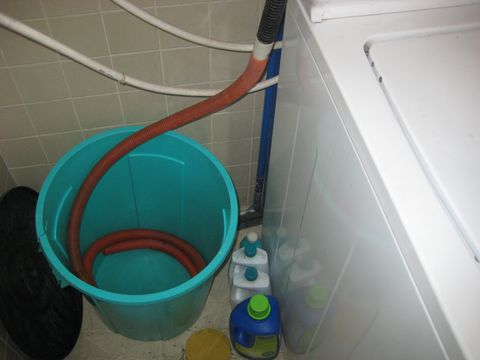
- If you are unable to collect rainwater, you can still find ways to collect and reuse greywater. Designate a pail for greywater in your bathroom. Collect the water you used in rinsing and washing when you wipe down furniture, clean the windows and handwash clothes. You can also redirect your washing machine outlet hose into a large bucket to collect soapy laundry water in, or collect the water from showering and washing your hair if you have a sturdy, shallow tub to stand in. Ensure that the water is not filled with dirt, hair and grease or it could clog up your plumbing and water pipes. The water should be only mildly dirty and soapy. You can use the water for flushing the toilet with, as flushing the toilet makes up about 31% of household water use.
- Water that you use for washing rice, vegetables and fruits can be collected and used for watering the plants.
- To reduce the amount of water used per flush, fill up a 0.5 litre plastic bottle with marbles or pebbles, top it up with water, seal the cap onto the bottle and put it in your toilet tank as a displacement device.
 
(Image credits: cristianlavaque.com)


4. Composting and gardening
- Apartment dwellers often complain that they are not able to practice composting or vegetable gardening, and as such feel disconnected to the earth. Find out if there are community gardens and edible gardens in your area that you can visit, volunteer at and contribute to if you miss gardening. Examples include the Free Tree Society of Kuala Lumpur, TTDI Edible Garden Project, and Eats Shoots and Roots.
- If there is any unused land in your apartment complex, ask the apartment management or Joint Management Committee if it can be converted into an edible garden. Have the area fenced up. Keys can be given only to residents involved in the project, to prevent pilfering and vandalism.
- Consider having a container garden, and customise it to fit your needs and your apartment's space constraints. Increase your space by growing vertically. You can grow pots of herbs, vegetables and spices on a vertical planter wall, in a pot stand, along the balcony grill, or in hanging pots suspended from a beam or hooks.
- Spider plants (Chlorophytum comosum) are a good indoor plant to have, as they improve air quality. Money plants (Epipremnum aureum) and Arrowhead plants (Syngonium podophyllum) are hardy green plants that are able to survive without soil. Simply immerse their roots in jars of water and place the jars in each room to improve air quality.
- You can try making compost in your balcony even without having to purchase a worm farm or bokashi bin. Cut your vegetable and fruit peels, bread crumbs and eggshells into pieces and let them dry out in an empty plant pot on the balcony. Do not compost cooked food, dairy or meat. Stir up the compost from time to time to prevent mould from forming. You can use the compost in your own potted plants once the plant matter has crumbled up and decomposed sufficiently, or you can give it to a community garden or a friend who has a garden. You can also toss into into the jungle, under the trees, during your next hike.
- If you do not receive enough direct sunlight on your balcony to make compost, and mould and smell is an issue, simply store your fruit and vegetable peels in the freezer until it is time to take it to a jungle or garden. Label a lidded jar or container clearly with the words "Compost". Fruit and vegetable peels should not smell or contaminate your refrigerator (remember that you are not supposed to compost rotten plant matter or cooked food) and will last for months in a freezer.

(Image credits: Mother Earth News.)

Eco Kids Column: Toys from Mother Nature-- Sticks

PENCINTA ALAM APRIL 2015
ECO KIDS COLUMN
 
TOYS FROM MOTHER NATURE: STICKS
By Wong Ee Lynn
<wongeelynn@yahoo.com / gl.mnselangor@yahoo.com>
 
Children have been playing with sticks since prehistory. You can pick up, throw, retrieve, bend, break and carve sticks. You can use sticks for digging, poking, building, fighting and creating new tools with. Even animals such as wolf cubs and dogs will throw, retrieve and play tug-of-war with sticks.
 
Many urban parents, however, are worried that playing with sticks will result in injury, especially to the eye. However, just as with climbing trees and crossing streams, the more often you play with sticks and other objects in nature, the more skillful you become at handling them, and the less likely you are to get hurt by them. You learn through experience what is the correct height to lift and throw sticks, and at what distance is someone safe from getting hurt.
 
As a general rule, however, do not lift any sticks higher than your eye level, and never use sticks to strike or poke someone else with, even lightly. Do not fight or engage in battle with your sticks, as someone could get seriously hurt. Do not beat or damage things, e.g. living plants, with your sticks. Choose sticks no longer than the length of your arm. Ensure that the sticks you pick up do not have latex, thorns, parasites, insects, splinters or sharp edges on them. Choose clean-looking sturdy sticks to play with and stop touching the sticks immediately if a rash or any form of allergic reaction occurs. Do not break branches off living plants, but pick up only the sticks you find lying on the ground.
 
Children and parents often feel as if they might get bored quickly if they were to go outdoors without bringing toys and electronic devices along with them. However, there are many games and activities you can carry out with the sticks you find and pick up. These activities can challenge your imagination, creativity, problem-solving skills and engineering skills.
 
1. Make a two-dimensional drawing in the sand using sticks. Break the sticks into shorter pieces or bend them to create the shapes you want, and press them into the sand so that they will lay flat. Start with simple drawings with straight lines, such as a house, rocket or robot. Now try more complex drawings. Can you draw a dinosaur? How about all the letters of the alphabet?
 
 
2. Have a challenge with a friend to build the tallest stick pole using only sticks and twine or rubber bands. At the word "Go", run into the woods and collect all the sticks you can. Tie the sticks together using twine or rubber bands to form the tallest pole possible. The pole has to be able to stand upright with you holding only the bottom stick.
 
3. Break or cut smaller sticks into equal lengths and use them to play Pick-Up-Sticks. The objective of this game is to pick out and remove sticks from a pile, one by one, without causing the other sticks in the pile to move. This game helps you develop patience, focus, logical thinking skills and a steady hand.
 
4. Build the biggest teepee or wigwam you can by arranging sticks into a cone shape and tying the ends at the top of the cone together. Depending on the size of your teepee, drape a bandanna, towel or sheet around the cone frame to complete your jungle shelter. Try building more complex shelters once you are good at this. Perhaps a kampung house, or a medieval castle?
 
5. Have a race to pick up litter along a beach or jungle trail using sticks. How will you pick those plastic bags and picnic cups up? Will you use two sticks like a pair of giant chopsticks? Will you spear rubbish on the end of a sharpened stick? Will you find a stick with a branch or fork in it, and use it to scoop up litter? The first one to successfully pick up 10 pieces of litter and transfer them into a rubbish bag wins the challenge.
 
6. Build a stick tower by layering and stacking sticks, layer by layer. You can turn this into a race and challenge each other to build the tallest tower within a designated time.

(Image credits: Childhood101.com)

 
7. Make a rustic-looking pen caddy or plant pot using a clean, empty steel can and an assortment of sticks. Choose only clean, sturdy sticks without insect holes and fungi and that are not hollow or brittle. Cut the sticks into equal lengths, a little longer than the height of the tin. Use glue or double-sided tape to glue or tape the sticks to the outer wall of the steel can, with the base of the sticks the same level as the base of the steel can so that the steel can will be able to stand upright on a flat surface. Cover the entire outer wall of the steel can so that no steel can be seen. Secure the sticks to the can using rubber bands, and cover the rubber bands using rope or twine. Now you have a rustic-looking pen caddy to hold your items in or even to use as a plant pot.

(Image credits: Pinterest)
 
8. Build rafts using sticks and rubber bands and launch them in a stream. Add a mast and sail if you like. How long will your raft last? Can it bear the weight of a few pebbles on it? Will it flip over, or hold steady?
 
9. Poke sticks upright into the sand or soil to form a maze. Roll a ping-pong ball through the maze. Your objective is to get the ball out of the maze by blowing at the ball through a cardboard tube. Alternatively, build a goalpost and poke more sticks in the position of a goalkeeper and defenders in front of the goalpost. Your objective is to try to blow or flick the ball into the goal without knocking over the goalie or defenders.
  
10. Tie 5 twigs or sticks together using rubber bands or twine to form a 5-sided star.

(Image credits: Childhood101.com)

Thursday, February 19, 2015

MNS Green Living teams up with TEEAM to collect e-waste and fluorescent lights

PENCINTA ALAM MARCH 2015
GREEN LIVING COLUMN
 
MNS Green Living teams up with TEEAM to collect e-waste and fluorescent lights.
(By Wong Ee Lynn, wongeelynn@yahoo.com)


MNS Green Living is pleased to report that our MNS Headquarters in Jalan Kelantan now has electronic waste (e-waste) and compact fluorescent light (CFL)/ fluorescent light (FL) collection bins, thanks to the assistance of The Electrical and Electronics Association of Malaysia (TEEAM). These bins are placed by the door to the MNS office, beside the Green Living Little Free Library, to enable members of the public to correctly dispose of their light bulbs, fluorescent light tubes and other electronic waste (e.g. batteries, unwanted appliances and gadgets) for recycling and safe disposal.
 
This initiative by TEEAM, a non-profit volunteer-based trade association, is made possible thanks to the UNDP-implemented GEF Small Grants Programme. However, Green Living strongly believes that the collection, recycling and safe disposal of hazardous wastes falls within the jurisdiction of the Ministry of Housing and Local Government and alternatively, the Ministry for Natural Resources and the Environment, and should not be made the responsibility of non-governmental organisations.
 
Representatives from TEEAM set up the bins and delivered an awareness talk at the MNS HQ on 7th Feb 2015. The eye-opening video presentation was followed by a lively discussion session. We would like to put on record our utmost appreciation to Dr. S.O. Lai and Ms. Thila of TEEAM for their tireless efforts in raising environmental awareness and facilitating the collection of e-waste.


To contact TEEAM, please email teeam52@gmail.com / teeam@teeam.org.my.

 
FACTS ON E-WASTE AND CFLs / FLs:
 
1. In Malaysia, used and discarded electrical and electronic appliances and components (including batteries) are commonly known as 'e-waste' and are categorised as scheduled waste under the code SW110, First Schedule, Environmental Quality (Scheduled Wastes) Regulations 2005 under the Environmental Quality Act 1974.
 
2. The SW110 wastes are defined as wastes from the electrical and electronic assemblies containing components such as accumulators, mercury switches, glass from cathode ray tubes and other activated glass or polychlorinated biphenyl-capacitators, or contaminated with cadmium, mercury, lead, nickel, chromium, copper, lithium, silver, manganese, or polychlorinated biphenyls.
 
3. If e-waste is disposed of in landfills, the opportunities to recover and recycle the metal, plastic or glass components would be lost. Further, hazardous metals and materials can leach out and contaminate soil, water and air.
 
4. In Peninsular Malaysia, all scheduled wastes, including e-waste, lightbulbs and light tubes, are collected for safe disposal and recycling by Kualiti Alam Sdn Bhd, a waste management and renewable energy development company.
 
5. CFLs and FLs are an energy-efficient alternative to incandescent lamps for the following reasons:
  • Three to four times more energy-efficient.
  • They cost less to use.
  • They reduce greenhouse gas emissions and other pollution from energy production.
  • They last up to ten times longer than standard incandescent light bulbs.
5. However, CFLs contain, on average 3 – 4 mg of mercury a unit. FL tubes contain, on average, 8.3 mg of mercury per unit.
 
6. All fluorescent lights and tubes are considered hazardous waste in Malaysia when they are discarded because they contain mercury. Mercury is a heavy metal with toxic effects. Exposure to, and contact with, mercury may lead to mercury poisoning, which can be lethal.
 
7. When mercury-containing CFLs or FLs are placed in the rubbish bins and collected for disposal, the lamps or tubes are broken and mercury is released to the environment. Mercury vapours from broken lamps or tubes can be absorbed through the lungs into the bloodstream. People who are particularly close to the breakage are especially at risk. Mercury from broken lamps and tubes can also be washed by rain water into waterways.
 
8. To prevent breaking fluorescent light bulbs and tubes, package fluorescent lamps and tubes carefully when storing and transporting them. Do not tape tubes together. Store and transport fluorescent lamps and tubes in their original boxes or another protective container. Store them in an area away from rain so that if they break, the mercury from broken lamps or tubes will not be washed by rain water into waterways.
 
9. In the event you accidentally break a fluorescent light or tube, vacate the room immediately and open all doors and windows. The only person(s) who should remain there are person(s) tasked with cleaning up. Do not use a standard household vacuum cleaner to clean up the broken pieces. Only a vacuum cleaner designed specifically for use with hazardous wastes may be used. However, most of us will not have one at hand.
 
Instead of vacuuming, wear latex gloves and carefully clean up the fragments. Use strips of duct tape or masking tape to pick up the fragments. Wipe the area with a damp sheet of newspaper or paper towel to remove all glass fragments and associated mercury.
 
Keep all people and pets away from area so that mercury-containing pieces and powder are not tracked into other areas.

Keep the area well ventilated to disperse any vapour that may escape.

After clean up is complete, place all fragments along with cleaning materials into a sealable plastic bag or lidded jar. Wash your hands. Recycle the pieces along with intact lamps if the recycling collection contractor permits it. Label the plastic bag or jar clearly to warn people who may be handling the broken bulbs to prevent injury or other harm to them.
 
10. When bringing your used CFLs and FLs to a CFL/FL collection bin, put the bulbs into their boxes for recycling. If you have not retained the bulb’s original box, use the box that the new/replacement bulb came in. If you have no bulb boxes at all, wrap the bulb in a sheet of newspaper and put it in a plastic or paper bag to prevent breakage before putting it in the CFL/FL collection bin.


Wednesday, January 28, 2015

MNS Green Living and TEEAM team up to recycle CFL light bulbs and tubes!


Lightbulb and E-Waste Collection and Recycling Programme and Awareness Talk


Date: Saturday, 7th February 2015

Time: 10.00 a.m. - 11.00 a.m.

Venue: MNS Headquarters (http://www.mns.my/spage.php?pg=contact)

The Electrical and Electronics Association of Malaysia (TEEAM) in collaboration with MNS Green Living will be setting up collection bins in the Malaysian Nature Society headquarters to enable members of the public to correctly dispose of their lightbulbs, fluorescent light tubes and other electronic waste (e.g. batteries, unwanted appliances and gadgets) for recycling and safe disposal.
- Why can't we just dispose of these items with our regular household waste?
- What constitutes scheduled waste?
- What happens to these items once they are sent for recycling?
- How do these items harm the environment and human health if not properly disposed of?
To find out the answers to these questions, please come for the awareness talk at the time and location stated above! Refreshments will be served and we would be happy to collect your light bulbs and e-waste from you on the same day. We will also conduct a Spot Quiz on light bulbs and e-waste recycling. This event is free of charge and open to all. We hope to see many concerned Earth citizens there!


Friday, January 9, 2015

Letter to the Editor: Stormwater Management Can Reduce Risk of Urban Flash Floods

LETTER TO THE EDITOR: 
STORMWATER MANAGEMENT CAN REDUCE RISK OF URBAN FLASH FLOODS 


Professor Chan Ngai Weng raised many salient points in his letter, 'The human factor in floods' (The Star, Jan 6). While the recent floods in the East Coast of Peninsular Malaysia and many coastal towns and villages received a lot of media attention and concern due to the unprecedented scale of destruction it left in its wake, we must not forget that Kuala Lumpur and many other Malaysian cities are also susceptible to flash floods. As someone who volunteers with the homeless communities, I have heard many accounts of how homeless individuals were swept away by the rapidly rising waters of the Gombak and Klang rivers during the monsoon season. Further, we are all familiar with the frequent traffic congestion and damage to property caused by flash floods. 

It is wonderful to witness the generosity, compassion and solidarity of Malaysians in contributing and delivering aid to the East Coast flood victims. However, unless urgent measures are taken to find and implement permanent solutions to the problem of flash floods, the floods will keep recurring, and Kuala Lumpur and other cities may soon find themselves having to deal with floods as devastating as those in the East Coast. 

The first step towards preventing and mitigating floods is without doubt, to halt deforestation. Biologically-diverse forests with their complex systems of canopies, roots, soil and leaf litter act as giant sponges which soak up rainwater and release the water slowly and evenly. Monoculture plantations could never be able to replicate this effect. The second step obviously lies in reducing sedimentation in rivers and waterways and blockages caused by littering. 

There are many things governments, local authorities, developers and property owners can do to reduce the risk of urban flash floods. Urban development has a profound impact on hydrologic cycles and water quality.  The penchant of property owners for tiling up their compounds with impermeable materials contributes directly to flash floods and downstream flooding. Rainwater cannot infiltrate naturally into the soil, but is instead channelled directly into storm drains and streams. This rapid disposal of stormwater causes downstream flooding because water channels are often too small for the sudden high flow. 

Water management agencies and the local authorities need to encourage responsible stormwater management and educate houseowners and commercial property owners that if stormwater is captured at its source and gradually released downstream, the impact on rivers would be mitigated and, consequently, the likelihood of soil erosion, water pollution and flash floods would be greatly reduced. The Drainage and Irrigation Department has advocated this ‘control at source’ method in the past but there has been no active enforcement of these guidelines by those with the authority to do so. 

To discourage littering and to allow water to be absorbed into the soil, it is recommended that open drains be replaced with gravel trenches, permeable pavements and buried waterways. Gravel trenches will not only slow down the water runoff and allow water to seep into the soil, it will also trap solid waste (e.g. fallen leaves and litter) and prevent these from being washed downstream and causing blockages. In addition, litterbugs are far less likely to throw rubbish into a gravel trench than into an open drain. 

Guidelines must be drawn up by the state governments and local authorities to ensure that pavements and driveways in new development projects may be tiled only with water permeable tiles such as interlocking bricks. Housing developers and property owners who wish to renovate their homes should be subjected to these same guidelines for drainage and tiling. Urban renewal and upgrading projects should include measures to replace impervious surfaces (concrete slabs, tiles) with permeable surfaces (porous bricks, interlocking bricks), planting trees, groundcover and shrubs in open areas and creating 'buffer strips' with indigenous water-loving native plants alongside waterways and in flood-susceptible parts of town to filter and slow down water runoff and soak up pollutants. Currently the upgrading of the Medan Pasar area into a 'historical walk' has exacerbated the risk of flash flooding, as it has replaced tar-bound macadam roads and shrubbery with impermeable tiled surfaces. It is hoped that it is not too late to incorporate some buffer strips in the area with gravel trenches and native plants with roots directly in the soil and not in concrete or plastic planters. 

Property owners and apartment management bodies should also take steps to implement similar measures in their renovation and beautification projects. Beautification should not only mean creating surfaces that are easy to maintain and clean, but also finding ways to mitigate damage to the environment, discourage littering and reduce inconvenience to residents in the form of traffic congestions, water damage and slippery surfaces.   The implementation of these stormwater management measures can help us find a means of controlling the volume of water run-off and, in the long run, may also improve water quality if action is taken to store and filter stormwater captured at its source before gradual release into rivers. 

WONG EE LYNN 
COORDINATOR, 
GREEN LIVING, 
MALAYSIAN NATURE SOCIETY