Showing posts with label Cooling and Heating. Show all posts

Wednesday, March 11, 2015

Green Living Column April 2015: Living Green In An Apartment

PENCINTA ALAM APRIL 2015
GREEN LIVING COLUMN
 
LIVING GREEN IN AN APARTMENT
 
A surprising number of people seem to believe that you need to live in landed property in the countryside in order to live a more environmentally-responsible lifestyle. Members of the public often say to the Green Living volunteers that they will start 'living greener' when they retire and are able to move to the countryside where they can plant trees, install solar panels and grow their own vegetables and fruits.
 
No-one ever has to wait to take steps that will make a positive difference to the environment or community. Many studies have shown that apartment dwellers in busy cities often have a smaller carbon footprint than those who live in houses. Some of the reasons for this include the following:
 
1. Apartments take up much less physical space than a home. Hundreds of people can live in an apartment complex that takes up the same amount of space on the ground as a single family home. Apartments build up, while houses build out. Less land will be developed, and this has a better overall impact on the environment.
2. Apartments are typically smaller than landed properties, and thus require less energy to power, light, heat and cool. Apartment-dwellers do not have to worry about porch and back door lighting and electronic gates, or buying lawnmowers and leaf blowers.
3. Apartments in cities are generally closer to public transport hubs and stops. Transportation service providers generally cover areas with many residents, and this frequently includes apartment complexes. This reduces the need to drive and to own private vehicles, thus reducing energy use and carbon emissions.
4. Apartment dwellers generally buy less and own fewer pieces of furniture and electrical appliances compared to houseowners, due to space constraints. Apartment dwellers do not have the option of storing things in the driveway, attic, garden shed or covered backyard that houseowners do. As such, their consumption of goods and resources is generally lower than that of houseowners.
5. Resources and spaces are shared in apartment complexes. This means that there is only one swimming pool, playground, gym, garden, yard, multipurpose hall and one set of parameter lighting and recycling bins that need to be maintained, repaired and cleaned. The rubbish collection truck only needs to make one stop. Apartment dwellers will not have to worry about roof repairs, installing gutters, weeding and mowing the garden, or driveway and garden maintenance, and this reduces the economic and environmental cost of home ownership.
 
Although you may not have a compost heap, vegetable garden or solar panels in your apartment, here are ways in which you can live green and continue to reduce your carbon footprint in an apartment:
 
1. Reduce, reuse and recycle
-  Give due consideration to the environment and your space constraints before you buy or acquire anything else for your apartment. Instead of having the mentality that you can donate or give an item away later if you no longer need it or if it is not a good fit for your apartment, consider not acquiring it in the first place, thus reducing waste. Refer to blogs such as Zero Waste Home (www.zerowastehome.com) and Becoming Minimalist (http://www.becomingminimalist.com/) to find inspiration on what you can live without and other ways to make do.
- Consider joining or setting up a cause similar to Craigslist, Freecycle and TTDI Free Market (https://www.facebook.com/events/655261001183666) to swap, donate or acquire preloved items. If you are in the apartment joint management panel/committee, consider holding a Yard Sale or Free Market to enable residents to share and reuse resources. You could also set up a Borrowing Shop where residents can borrow or rent infrequently-used items such as hand tools, baking equipment and children's items.
- If there are no recycling bins in your apartment complex, request the building management or joint management committee to write in to Alam Flora or other waste management companies or organisations to set up recycling bins in the lobby of the apartment complex. You can also contact organisations such as TEEAM (Email teeam@teeam.org.my / teeam52@gmail.com) to request the setting up of electronic waste collection bins and Persatuan Amal Sri Sinar / Buddhist Tzu Chi Merit Society / Rotary Club for the setting up of donation bins for used clothes, household items and recyclables. The bins should preferably be placed in a well-lit area with lots of foot traffic to prevent vandalism and the dumping of dirty and unsuitable materials in the bins.
 
2. Electricity usage
- Solar photovoltaic (PV) panels are only a good investment if your energy usage is high, or if your roof receives direct sunlight daily (i.e. not blocked by higher buildings or hills). A good alternative to installing solar PV panels would be to reduce energy usage as a whole, and to put up high-quality solar lights (e.g. Nokero solar light bulbs) in windows, balconies and areas that receive plenty of direct sunlight. This way, you save on lighting areas such as the balcony, bathrooms and rooms which are not used for reading, using the computer or doing work which requires bright lighting.
- To save on energy bills, use curtains, blinds and window tints to cut down on solar heat entering the apartment in the daytime. This will reduce the need for air-conditioning in the apartment unit. If you need to use an air-conditioning unit, switch it on only long enough to cool down the room, and then switch it off, and switch on the fan to circulate the cool air instead.
- Most of the energy used in residential homes is used for heating and cooling. The fewer heat-generating appliances you have in a home (e.g. dishwasher, dryer, oven, steam vacuum cleaner), the less need you have for air-conditioning, and the lower your energy bills. Wash dishes by hand and hang laundry out to dry. Stagger your laundry days to ensure that each load of laundry has a day or two to air-dry. Laundry racks and lines that can be put away when not in use can help you create more space to hang laundry out in, without creating unsightly clutter.
 
3. Water conservation
- Many apartment dwellers complain that they are unable to collect rainwater for reuse. If you have a balcony or corridor that is exposed to the rain, you might want to consider putting up lightweight PVC or aluminium rain gutters to channel rainwater into a rain barrell. Create a water permeable cover for the rain barrell using mosquito screen or wire mesh to prevent mosquitoes and other insects from breeding in the rainwater. Use the water for cleaning, flushing the toilet and watering plants.
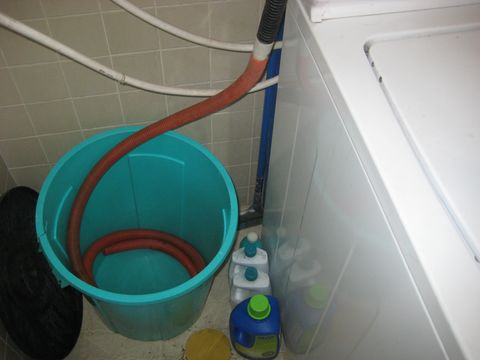
- If you are unable to collect rainwater, you can still find ways to collect and reuse greywater. Designate a pail for greywater in your bathroom. Collect the water you used in rinsing and washing when you wipe down furniture, clean the windows and handwash clothes. You can also redirect your washing machine outlet hose into a large bucket to collect soapy laundry water in, or collect the water from showering and washing your hair if you have a sturdy, shallow tub to stand in. Ensure that the water is not filled with dirt, hair and grease or it could clog up your plumbing and water pipes. The water should be only mildly dirty and soapy. You can use the water for flushing the toilet with, as flushing the toilet makes up about 31% of household water use.
- Water that you use for washing rice, vegetables and fruits can be collected and used for watering the plants.
- To reduce the amount of water used per flush, fill up a 0.5 litre plastic bottle with marbles or pebbles, top it up with water, seal the cap onto the bottle and put it in your toilet tank as a displacement device.
 
(Image credits: cristianlavaque.com)


4. Composting and gardening
- Apartment dwellers often complain that they are not able to practice composting or vegetable gardening, and as such feel disconnected to the earth. Find out if there are community gardens and edible gardens in your area that you can visit, volunteer at and contribute to if you miss gardening. Examples include the Free Tree Society of Kuala Lumpur, TTDI Edible Garden Project, and Eats Shoots and Roots.
- If there is any unused land in your apartment complex, ask the apartment management or Joint Management Committee if it can be converted into an edible garden. Have the area fenced up. Keys can be given only to residents involved in the project, to prevent pilfering and vandalism.
- Consider having a container garden, and customise it to fit your needs and your apartment's space constraints. Increase your space by growing vertically. You can grow pots of herbs, vegetables and spices on a vertical planter wall, in a pot stand, along the balcony grill, or in hanging pots suspended from a beam or hooks.
- Spider plants (Chlorophytum comosum) are a good indoor plant to have, as they improve air quality. Money plants (Epipremnum aureum) and Arrowhead plants (Syngonium podophyllum) are hardy green plants that are able to survive without soil. Simply immerse their roots in jars of water and place the jars in each room to improve air quality.
- You can try making compost in your balcony even without having to purchase a worm farm or bokashi bin. Cut your vegetable and fruit peels, bread crumbs and eggshells into pieces and let them dry out in an empty plant pot on the balcony. Do not compost cooked food, dairy or meat. Stir up the compost from time to time to prevent mould from forming. You can use the compost in your own potted plants once the plant matter has crumbled up and decomposed sufficiently, or you can give it to a community garden or a friend who has a garden. You can also toss into into the jungle, under the trees, during your next hike.
- If you do not receive enough direct sunlight on your balcony to make compost, and mould and smell is an issue, simply store your fruit and vegetable peels in the freezer until it is time to take it to a jungle or garden. Label a lidded jar or container clearly with the words "Compost". Fruit and vegetable peels should not smell or contaminate your refrigerator (remember that you are not supposed to compost rotten plant matter or cooked food) and will last for months in a freezer.

(Image credits: Mother Earth News.)

Friday, August 8, 2014

Eco Kids Column: Keeping Cool In The Heatwave

Eco Kids Column, Pencinta Alam Sept 2014

Keeping Cool In The Heatwave
By Wong Ee Lynn

The recurring hot and dry season can be a source of discomfort and frustration for many. Some people complain that they are unable to sleep at night without an air-conditioning unit in their bedrooms. If you are one of those people, you may want to consider these tips to help you keep cool:

If you do not have an air-conditioned bedroom:
1. Keep the house shut tight during the day. Don't let in unwanted heat and humidity. Open up the windows to ventilate at night either naturally or with fans. 
2. Install awnings on windows to provide shade.
3. Plant trees for shade around the house, especially as ‘sun-breakers’ outside windows.
4. Install window shades or mini-blinds. Mini-blinds can reduce solar heat gain by 40-50%.  
5. Have a cold shower or a cold drink before bed to help bring your temperature down.

If you do have an air-conditioning unit in your home:
1. We hope it is a high-efficiency air conditioner with Energy Star ratings!
2. Do not use a dehumidifier at the same time your air conditioner is operating. The dehumidifier will increase the cooling load and force the air conditioner to work harder. 
3. To reduce energy wastage, seal all air conditioner ducts.
4. Keep the thermostat set at 23 degrees Celsius or higher if using ceiling fans. Don't air-condition unused rooms.
5. Maintain your air conditioners properly to maximise efficiency. Clean the filters every month if you use it frequently. Normal dust build-up can reduce airflow by 1% per week.
6. Provide shade for your room air conditioner, or the outside half of your central air conditioner if at all possible. This will increase the unit's efficiency by 5 - 10%.
7. Consider sharing an air-conditioned sleeping space with your parents or siblings to reduce the need to use an air-conditioner in more than one room. 
8. Use the timer to switch your air-conditioner off after 1-2 hours, when the room is sufficiently cool and you are already asleep. Keep your fan on to ventilate the room. The room should be able to remain cool until morning. 
9. Switch on the air-conditioner only after you have entered the room. Don't keep an air-conditioner running if there is no-one in the room. Always switch it off when the room is sufficiently cool, and do not keep it running longer than is necessary. 


Here is a DIY Project called a 'Poor Man's Air-Conditioning Unit', which has proven popular with students and renters! The best thing is that it uses items you already have, or items that would otherwise be recycled or discarded. 
You need:
1. 2 or more beverage bottles. Fill with water and freeze. 
2. A table or standing fan.
3. Boxes, step stools or books to bring the bottles to the same height as the fan blades.
4. Trays or plastic takeout containers.

Instructions:
1. Freeze the bottles of water way ahead of time. The bigger the bottle of water, the longer the cooling effect will last. The trouble, however, is that not many people have the room to fit 2 large 1.5 litre soda bottles in their freezer! The cooling effect of 0.5 litre bottles like the ones in the picture will last at least for an hour.
2. Use the boxes, books or stepping stools to bring the bottles up to the height of the fan blades. Place the bottles upright in front of the fan so that the wind will blow through the column of frozen water bottles.
3. Put the bottles standing upright in the trays or takeout containers to capture the condensation and stop the water from damaging books and furniture.
4. Switch the fan on and allow the wind to blow through the column of frozen water bottles and at you. In the morning, remember to put the bottles back into the freezer so that they will have time to freeze and you will be able to use them again the following night.

Stay cool, use energy and resources wisely and tread gently on the good Earth!

Thursday, April 26, 2012

Taking Action to Curb Climate Change

TAKING ACTION TO CURB CLIMATE CHANGE  
By Wong Ee Lynn 
Coordinator 
Green Living 
Special Interest Group 
Selangor Branch

Human well-being, we have learned, is linked more closely than most people realise to the great marine and terrestrial ecosystems. Carbon emissions must not exceed Nature's capacity to withdraw carbon dioxide from the atmosphere and neutralise the carbon. Carbon dioxide is part of life, yet rising carbon dioxide levels are implicated as the primary cause of climate change since 1950. In order to mitigate climate change-related environmental damage, our only hope is to ensure that emissions of CO2 from human activities are limited to levels that can be absorbed by trees and plants through photosynthesis. The Challenge: The world's inhabitants will need to find politically acceptable ways to reduce their CO2 emissions level by 80%.

Personal choices are not a substitute for political action. Global problems could only be comprehensively solved through actual reforms in public policies that engage most people and institutions. Similarly, however, political action is no substitute for leading lives that reflect our environmental values. As long as people keep buying energy guzzlers (e.g. big vehicles as status symbols, large mansions for small families), businesses and manufacturers will continue producing them. The following are commonsense actions each of us can take to effectively reduce greenhouse gas emissions from our homes, cars and businesses. These suggestions also happen to cut our expenses and improve our health and quality of life.  


INCREASING YOUR FUEL EFFICIENCY:
Every litre of fuel we burn releases approximately 2.6 kilograms of carbon dioxide into the atmosphere. We can, however, significantly reduce our road transport emissions by planning our trips and errands and practicing efficient driving techniques.  

1. Observe the Speed Limit
Over 50% of the energy required to move a vehicle down the road is spent overcoming aerodynamic drag (pushing air out of the way). When driving faster, the aerodynamic drag and rolling resistance increase. Consequently, the fuel economy decreases rapidly at speeds above 60 mph.  

2. Overdrive Gears and Cruise Control
When using overdrive gears, it's possible to still drive at highway speeds, but the engine speed decreases. Overdrive gears reduce both fuel consumption and engine wear. Also, using cruise control on highway trips helps maintain a constant, steady speed rather than a variable speed and as a result helps reduce fuel consumption.

3. Anticipate Traffic Situations
Anticipating traffic conditions ahead and not tailgating can improve gas mileage by 5 to 10 percent. This driving strategy is not only safer, but also reduces wear on tyres and brakes. When driving in the city, nearly 50 percent of the energy needed to power a vehicle is for acceleration. Unnecessary braking wastes that energy. Avoid driving during rush hours. Leaving your home for the office half an hour earlier, and leaving the office only after the traffic jam has subsided, can help you make huge fuel savings.  

4. Avoid Unnecessary Idling
No matter how efficient the car is, unnecessary idling wastes fuel, costs money and pollutes the air. If waiting for more than a couple of minutes, turn off the engine. Also, do not leave the car idling while running into a store for a "quick" errand, as it is also an open invitation for auto theft.  

5. Carpooling, Mass Transit, People Power and Telecommuting
On one or more days a week consider: - Carpools and ride-share programs - Walking or biking to work - Telecommuting one or more days a week 6. Vacations A loaded roof rack can decrease fuel economy by as much as 5%. Therefore, to reduce the aerodynamic drag of these space savers and improve fuel economy, place items inside the trunk whenever possible.  

7. Tyre Maintenance
Be sure the tyres are properly inflated. Car manufacturers are required to place a label in the car stating the correct tyre pressure. This label may be found on the edge of the door or door jamb, in the glove box, or on the inside of the gas cap cover. If the label lists a psi range, use the higher number in order to maximize fuel efficiency. Under-inflated tyres cause fuel consumption to increase by as much as 6%, cause the tyres to wear quicker and can make it difficult to handle the vehicle. Be sure wheels are aligned and brakes are properly adjusted to minimize rolling resistance.  

8. Change Your Motor Oil and Air Filter Regularly
Changing the oil regularly will increase the life of the car's engine. Clean oil reduces wear caused by friction between moving parts and it removes harmful dirt and grit from the engine. The car's air filter keeps impurities in the air from damaging internal engine components. Not only will replacing a dirty air filter improve fuel economy, it will protect the engine. Clogged filters can cause up to a 10% increase in fuel consumption.  

9. Keep Your Engine Tuned
Studies have shown that, depending on a car's condition; a poorly tuned engine can increase fuel consumption by as much as 10-20 percent. Following the recommended maintenance schedule in the owner's manual will save fuel, help the car run better and last longer.  

ENERGY CONSERVATION AT HOME:
Households use over 1/5 of the total energy consumed in the country. An average suburban family creates 4.5 tons of carbon dioxide from home electricity use every year. Adopting these simple, low-cost energy conservation measures could reduce staggering amounts of carbon emissions.  

While Cooking:
1. Match the size of the gas ring to the size of the saucepan or you will be paying to heat air.
2. Put a lid on saucepans, so the contents heat quicker and you use less energy.
3. Pressure cookers and steamers are more efficient and allow you to cook several different foods on one ring. 4. Microwaves use less energy than ovens and do not require preheating.  

Electrical Appliances:
1. Don’t leave appliances like TVs, stereos, PCs and cordless phones on standby mode.
2. Unplug equipment once fully charged - e.g. mobile phones, shavers, batteries and electric toothbrushes - otherwise they keep drawing electricity.
3. Buy high quality appliances with Energy Star ratings. Cheap, generic appliances may appeal to the impulse buyer, but they use energy less efficiently and will cost you more money in the long run in terms of utility bills and the cost of repairs and replacements.  

Refrigeration:
1. Avoid leaving fridge doors open. Each minute the door is open takes three minutes of energy to cool down again.
2. Avoid putting hot or warm food straight into the fridge. Allow it to cool first.
3. Defrost your fridge regularly to keep it running efficiently and cheaply. If it seems to frost up quickly, check the door seal.
4. Keep the fridge in a cool room. Set temperatures accurately: Fridge 5°C; Freezer 18°C.  

Washing machine and dishwasher:
1. Wash on the low-temperature programme.
2. Try to have full loads when using the washing machine and dishwasher.  

Tumble dryer:
1. In sunny weather, dry your clothes outside and enjoy the fresh smell that only comes from line-dried clothes.
2. If you have to use a tumble dryer, don’t put very wet clothes inside. Wring them out or spin-dry them first.  

Lighting:
1. Keep window ledges clear of clutter to get the most daylight in your home. Pull curtains back during the day and keep plants trimmed so they don’t block incoming light. Keep bulbs and shades clean.
2. Turn off lights when not needed.
3. Dimmer switches reduce consumption and help create the lighting effect you want.
4. Fluorescent lights use less electricity than ordinary bulbs.
5. Energy saving light bulbs use 80% less than ordinary bulbs, and last ten times longer.
6. When away, outside lights can be arranged to come on automatically, instead of being left on permanently.
7. Light-coloured walls, ceilings and floors, as well as mirrors, reflect daylight, making maximum use of natural light.

REDUCING YOUR HOME COOLING LOAD:
Studies have shown that 42% of an average family's energy bill is spent to keep homes at a comfortable temperature. Strive to reduce the cooling load of your air-conditioning units by employing cost-effective conservation measures. The efficient cooling tips below save money and energy, and improve our comfort levels:
1. If possible, delay heat-generating activities like dishwashing and ironing until evening.
2. Keep the house shut tight during the day. Don't let in unwanted heat and humidity. Ventilate at night either naturally or with fans.
3. Install awnings on windows to provide shade.
4. Plant trees for shade around the house, especially as ‘sun-breakers’ outside windows.
5. If you absolutely need air conditioners, buy a high-efficiency air conditioner with Energy Star rating.
6. Your air-conditioner’s size and horsepower should be as according to your needs. When buying a new air conditioner, make sure it is not oversized.
7. Do not use a dehumidifier at the same time your air conditioner is operating. The dehumidifier will increase the cooling load and force the air conditioner to work harder.
8. To reduce energy wastage, seal all air conditioner ducts.
9. Keep the thermostat set at 78 degrees F or higher if using ceiling fans. Don't air-condition unused rooms.
10. Maintain your air conditioners properly to maximize efficiency. Clean the filters every month if you use it frequently. Normal dust build-up can reduce airflow by 1% per week.
11. Provide shade for your room air conditioner, or the outside half of your central air conditioner if at all possible. This will increase the unit's efficiency by 5 - 10%.
12. Install window shades or mini-blinds. Mini-blinds can reduce solar heat gain by 40-50%.  

CONCLUSION
It is crucial that each of us understand the role we have to play in tackling climate change. Climate change is a result not only of factory emissions and government logging concessions, but also of everyday actions such as switching on appliances and purchasing foam food packaging. All over the world today, communities and non-profit organisations have instituted climate change initiatives, while individuals have made behavioural modifications to reduce the impact of their daily habits on the environment. Our actions must be borne out of a deep personal conviction that what we do is meaningful and is crucial in the battle against environmental damage and degradation. Facing the challenge today will lead us into a cleaner, greener future tomorrow.

Cool your home, naturally

COOL YOUR HOME, NATURALLY

Reduce the cooling load of your air-conditioning units by employing cost-effective conservation measures. Efficient cooling saves money and energy, and improves the quality of our lives.
1. If possible, delay heat-generating activities like dishwashing and ironing until evening.
2. Keep the house shut tight during the day. Don't let in unwanted heat and humidity. Ventilate at night either naturally or with fans.
3. Install awnings on windows to provide shade.
4. Plant trees for shade around the house, especially as ‘sun-breakers’ outside windows.
5. If you absolutely need air conditioners, buy a high-efficiency air conditioner with Energy Star rating.
6. Your air-conditioner’s size and horsepower should be as according to your needs. When buying a new air conditioner, make sure it is not oversized.
7. Do not use a dehumidifier at the same time your air conditioner is operating. The dehumidifier will increase the cooling load and force the air conditioner to work harder.
8. To reduce energy wastage, seal all air conditioner ducts.
9. Keep the thermostat set at 78 degrees F or higher if using ceiling fans. Don't air-condition unused rooms.
10. Maintain your air conditioners properly to maximize efficiency. Clean the filters every month if you use it frequently. Normal dust build-up can reduce airflow by 1% per week.
11. Provide shade for your room air conditioner, or the outside half of your central air conditioner if at all possible. This will increase the unit's efficiency by 5 - 10%.
12. Install window shades or mini-blinds. Mini-blinds can reduce solar heat gain by 40-50%.