Showing posts with label Water Conservation. Show all posts

Monday, July 29, 2019

Letter to the Editor: Consider Alternatives To Groundwater Extraction


LETTER TO THE EDITOR:
CONSIDER ALTERNATIVES TO GROUNDWATER EXTRACTION


Minister of Water, Land and Natural Resources Dr. Xavier Jayakumar’s proposal to tap into Malaysia’s groundwater supply to meet growing water demand is baffling, considering that there are many other less costly and destructive means of meeting our country’s water needs.

That the Minister reported of forests in Kedah catching fire due to drought is precisely what environmentalists and concerned citizens have been warning the authorities about for years – protect water catchment areas, gazette the Ulu Muda Forest Complex, and end deforestation, or we will face a water crisis.

A fully-grown tree releases 1,000 litres of water vapour a day into the atmosphere. Thus logging leads to higher temperatures and a decline in rainfall due to the reduced ability of a cleared or decimated forest to absorb solar energy and release water vapour. 

The 2016 drought affecting the northern states of Peninsular Malaysia is directly linked to logging activities in the Ulu Muda forest complex, which affected climate and water cycle patterns, resulting in a massive decline in dam water levels and a postponement of the paddy planting season.

Now that a water crisis is imminent, the Minister has made the alarming proposal to drain other sources of water, rather than manage the resource that best ensures a sustainable and consistent supply of water – our tropical rainforests, which act as vital water catchment zones.

It is essential that we protect our remaining forests and maintain the health of our rivers, wetlands and water catchment areas to ensure that water resources are safe for us and can be sustained for future generations.

Tapping into our groundwater supply while failing to protect water catchment areas, manage water demand, and end non-revenue water loss, is like withdrawing funds from an already overdrawn bank account.

The sustained pumping of groundwater can lead to groundwater depletion and deterioration of water quality. As water levels in lakes and rivers are also linked to groundwater seepage, the excessive drawing of groundwater can result in a decline in the water levels of lakes and rivers and the loss of riparian vegetation and wildlife habitats.

When groundwater is continually pumped out of the earth, it can result in land subsidence, namely, the collapse and sinking of soil. This can result in disasters such as the opening up of sinkholes and surface cavities such as in New Orleans after Hurricane Katrina, the tilting and cracking of buildings such as in Mexico City, and severe flooding such as in Bangkok. Studies have shown that land subsidence can continue for decades even after groundwater pumping has been stopped, as was observed in Arizona.

The Minister should instead seriously consider water conservation measures while options are still available to us, before our water supply has dropped to crisis levels. 

We can learn from the example of the State of California, which faced a drought and water crisis in 2015. In April 2015, California Governor Jerry Brown ordered a 25% reduction in urban water use.  Amazingly, within one month of the water reduction law being implemented, California's water usage went down by not merely 25% but 29%.

Their water conservation measures included emergency adoption of building codes to conserve water, rebates for water-saving devices and landscape conversion and irrigation, water-efficient landscaping, imposing a fine for water wastage, local outdoor watering restrictions, statewide regulations requiring businesses to serve water to customers and launder linens and towels only when specifically requested, and hefty penalties for farmers who pump water from drought-stricken rivers. In a world where clean water is becoming increasingly scarce, it is important that we adopt the best and most cost-effective water conservation practices from around the world such as those implemented by the State of California.

The solution to our country's water problems lies not in tapping into underground water reserves, the construction of an infinite number of dams, or in water rationing for domestic users, but in protecting vital watershed areas, repairing and maintaining the existing water supply infrastructure to minimise non-revenue water loss, and to promote and enforce more efficient water use.

By the Minister’s own admission, non-revenue water loss in Malaysia is calculated to be at the rate of 5,929 million litres per day of treated water, which is sufficient to meet the water demand in both Selangor (3,316 million litres a day) and Johor (1,320 million litres a day). Surely the priority of the Minister should be replace leaky and damaged water infrastructure and end water theft, rather than to extract water from an ever-increasing number of natural sources?

As for the argument that watershed conservation, water-saving measures, and the replacement of old pipes and water supply systems to plug non-revenue water loss will burden the rakyat, it is submitted that constructing yet more dams and groundwater extraction infrastructure will cost taxpayers even more. Given the choice between paying for a temporary solution to water shortage issues (i.e. dams and groundwater wells that will result in environmental destruction or will eventually dry up) and a more durable solution to protect water security (i.e. protection of watersheds, replacement of unsafe and leaking water supply pipes with safer and sturdier pipes, tiered pricing system to penalise only water wastage and heavy water use), I believe most taxpayers and consumers would make the rational decision to spend their money on the latter.  

A responsible government is one that makes decisions that will protect the safety, health, and food and water security of its citizens, and environmental and ecological integrity for generations to come, regardless of who will hold political power then.


WONG EE LYNN
PETALING JAYA, SELANGOR

Tuesday, March 14, 2017

Letter to the Editor: Protect Ulu Muda from Logging

LETTER TO THE EDITOR
PROTECT ULU MUDA FROM LOGGING
 
The report of continued logging activities in the Ulu Muda forest complex (The Star, 9 March 2017) is a cause for alarm. The Green Living Special Interest Group of the Malaysian Nature Society supports the call of Sahabat Alam Malaysia and the Penang Water Supply Corporation to terminate all logging and quarrying activities in the Ulu Muda forest complex immediately.
The 160,000-hectare forest complex, covering 7 forest reserves, is a critical water catchment area for the northern states of Kedah, Perlis and Penang and supplies water to, among others, the Ahning, Muda and Pedu Dams. According to the World Wildlife Fund for Nature (WWF) Malaysia, the Ulu Muda forest complex supplies as much as 96% of Kedah’s, 50% of Perlis’ and 80% of Penang’s water supply.
 
The Kedah State Government has been aware of the logging activities in the Ulu Muda Forest Reserve for years, and the Kedah Water Supply, Water Resources and Energy Committee had assured the public since last year that it would look into the issue of logging permits and the possibility of gazetting the entire forest reserve as a water catchment area (The Star, 16 May 2016).
 
The 2016 drought affecting the northern states of Peninsular Malaysia is directly linked to logging activities in the Ulu Muda forest complex, which affected climate and water cycle patterns, resulting in a massive decline in dam water levels and a postponement of the paddy planting season.
 
In addition to providing water for domestic, industrial and agricultural use, Ulu Muda also provides vital ecological services such as climate regulation, soil erosion prevention, biodiversity conservation and maintenance of soil, water and air quality.
 
Without the root system of this rainforest complex to absorb and slowly release rainwater, heavy monsoon rains would end up washing over the exposed cleared forests, resulting in soil erosion, landslides, flash floods and the silting of rivers. Forest clearing releases stored carbon dioxide, which traps heat and contributes to atmospheric warming.
 
A fully-grown tree releases 1,000 litres of water vapour a day into the atmosphere. The reduced ability of a cleared or decimated forest to absorb solar energy and release water vapour leads to higher temperatures and a decline in rainfall. One can imagine the ecological fallout if logging were allowed to continue in Ulu Muda. 
 
From a human dimension, Ulu Muda provides economic and sociocultural services which include ecotourism, the harvesting of forest products and a home for indigenous and rural communities.
 
The preservation of the Ulu Muda forest complex is not a political issue and not merely the concern of environmental organisations. It affects the very survival and food and water security of a significant percentage of the population of Peninsular Malaysia. When the survival of present and future populations is at stake, apportioning blame to political parties and previous administrations is unproductive and downright harmful.
 
Malaysia stands to gain more economic benefits from keeping its forests intact and biologically diverse, than from issuing permits for logging, mining and road construction in forested areas. The economic benefits of logging are short-lived and can sustain only 1-2 generations at most. If the federal and state governments wish to cultivate long-term prosperity, they need to afford greater protection to rainforests, which are worth more alive than dead. There is little point in governmental and municipal initiatives such as recycling and tree-planting campaigns, which smack of environmental tokenism, if state governments and the Federal Government are unwilling to cooperate to conserve and protect the Ulu Muda forest complex.  
 
WONG EE LYNN
COORDINATOR,
GREEN LIVING SPECIAL INTEREST GROUP,
MALAYSIAN NATURE SOCIETY

Wednesday, March 11, 2015

Green Living Column April 2015: Living Green In An Apartment

PENCINTA ALAM APRIL 2015
GREEN LIVING COLUMN
 
LIVING GREEN IN AN APARTMENT
 
A surprising number of people seem to believe that you need to live in landed property in the countryside in order to live a more environmentally-responsible lifestyle. Members of the public often say to the Green Living volunteers that they will start 'living greener' when they retire and are able to move to the countryside where they can plant trees, install solar panels and grow their own vegetables and fruits.
 
No-one ever has to wait to take steps that will make a positive difference to the environment or community. Many studies have shown that apartment dwellers in busy cities often have a smaller carbon footprint than those who live in houses. Some of the reasons for this include the following:
 
1. Apartments take up much less physical space than a home. Hundreds of people can live in an apartment complex that takes up the same amount of space on the ground as a single family home. Apartments build up, while houses build out. Less land will be developed, and this has a better overall impact on the environment.
2. Apartments are typically smaller than landed properties, and thus require less energy to power, light, heat and cool. Apartment-dwellers do not have to worry about porch and back door lighting and electronic gates, or buying lawnmowers and leaf blowers.
3. Apartments in cities are generally closer to public transport hubs and stops. Transportation service providers generally cover areas with many residents, and this frequently includes apartment complexes. This reduces the need to drive and to own private vehicles, thus reducing energy use and carbon emissions.
4. Apartment dwellers generally buy less and own fewer pieces of furniture and electrical appliances compared to houseowners, due to space constraints. Apartment dwellers do not have the option of storing things in the driveway, attic, garden shed or covered backyard that houseowners do. As such, their consumption of goods and resources is generally lower than that of houseowners.
5. Resources and spaces are shared in apartment complexes. This means that there is only one swimming pool, playground, gym, garden, yard, multipurpose hall and one set of parameter lighting and recycling bins that need to be maintained, repaired and cleaned. The rubbish collection truck only needs to make one stop. Apartment dwellers will not have to worry about roof repairs, installing gutters, weeding and mowing the garden, or driveway and garden maintenance, and this reduces the economic and environmental cost of home ownership.
 
Although you may not have a compost heap, vegetable garden or solar panels in your apartment, here are ways in which you can live green and continue to reduce your carbon footprint in an apartment:
 
1. Reduce, reuse and recycle
-  Give due consideration to the environment and your space constraints before you buy or acquire anything else for your apartment. Instead of having the mentality that you can donate or give an item away later if you no longer need it or if it is not a good fit for your apartment, consider not acquiring it in the first place, thus reducing waste. Refer to blogs such as Zero Waste Home (www.zerowastehome.com) and Becoming Minimalist (http://www.becomingminimalist.com/) to find inspiration on what you can live without and other ways to make do.
- Consider joining or setting up a cause similar to Craigslist, Freecycle and TTDI Free Market (https://www.facebook.com/events/655261001183666) to swap, donate or acquire preloved items. If you are in the apartment joint management panel/committee, consider holding a Yard Sale or Free Market to enable residents to share and reuse resources. You could also set up a Borrowing Shop where residents can borrow or rent infrequently-used items such as hand tools, baking equipment and children's items.
- If there are no recycling bins in your apartment complex, request the building management or joint management committee to write in to Alam Flora or other waste management companies or organisations to set up recycling bins in the lobby of the apartment complex. You can also contact organisations such as TEEAM (Email teeam@teeam.org.my / teeam52@gmail.com) to request the setting up of electronic waste collection bins and Persatuan Amal Sri Sinar / Buddhist Tzu Chi Merit Society / Rotary Club for the setting up of donation bins for used clothes, household items and recyclables. The bins should preferably be placed in a well-lit area with lots of foot traffic to prevent vandalism and the dumping of dirty and unsuitable materials in the bins.
 
2. Electricity usage
- Solar photovoltaic (PV) panels are only a good investment if your energy usage is high, or if your roof receives direct sunlight daily (i.e. not blocked by higher buildings or hills). A good alternative to installing solar PV panels would be to reduce energy usage as a whole, and to put up high-quality solar lights (e.g. Nokero solar light bulbs) in windows, balconies and areas that receive plenty of direct sunlight. This way, you save on lighting areas such as the balcony, bathrooms and rooms which are not used for reading, using the computer or doing work which requires bright lighting.
- To save on energy bills, use curtains, blinds and window tints to cut down on solar heat entering the apartment in the daytime. This will reduce the need for air-conditioning in the apartment unit. If you need to use an air-conditioning unit, switch it on only long enough to cool down the room, and then switch it off, and switch on the fan to circulate the cool air instead.
- Most of the energy used in residential homes is used for heating and cooling. The fewer heat-generating appliances you have in a home (e.g. dishwasher, dryer, oven, steam vacuum cleaner), the less need you have for air-conditioning, and the lower your energy bills. Wash dishes by hand and hang laundry out to dry. Stagger your laundry days to ensure that each load of laundry has a day or two to air-dry. Laundry racks and lines that can be put away when not in use can help you create more space to hang laundry out in, without creating unsightly clutter.
 
3. Water conservation
- Many apartment dwellers complain that they are unable to collect rainwater for reuse. If you have a balcony or corridor that is exposed to the rain, you might want to consider putting up lightweight PVC or aluminium rain gutters to channel rainwater into a rain barrell. Create a water permeable cover for the rain barrell using mosquito screen or wire mesh to prevent mosquitoes and other insects from breeding in the rainwater. Use the water for cleaning, flushing the toilet and watering plants.
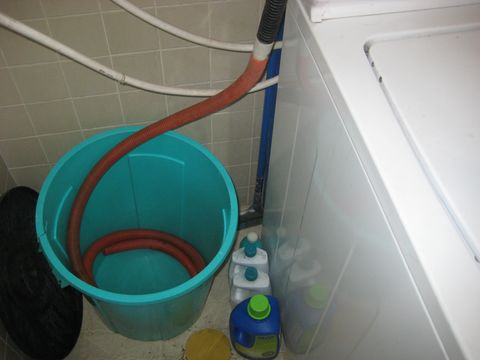
- If you are unable to collect rainwater, you can still find ways to collect and reuse greywater. Designate a pail for greywater in your bathroom. Collect the water you used in rinsing and washing when you wipe down furniture, clean the windows and handwash clothes. You can also redirect your washing machine outlet hose into a large bucket to collect soapy laundry water in, or collect the water from showering and washing your hair if you have a sturdy, shallow tub to stand in. Ensure that the water is not filled with dirt, hair and grease or it could clog up your plumbing and water pipes. The water should be only mildly dirty and soapy. You can use the water for flushing the toilet with, as flushing the toilet makes up about 31% of household water use.
- Water that you use for washing rice, vegetables and fruits can be collected and used for watering the plants.
- To reduce the amount of water used per flush, fill up a 0.5 litre plastic bottle with marbles or pebbles, top it up with water, seal the cap onto the bottle and put it in your toilet tank as a displacement device.
 
(Image credits: cristianlavaque.com)


4. Composting and gardening
- Apartment dwellers often complain that they are not able to practice composting or vegetable gardening, and as such feel disconnected to the earth. Find out if there are community gardens and edible gardens in your area that you can visit, volunteer at and contribute to if you miss gardening. Examples include the Free Tree Society of Kuala Lumpur, TTDI Edible Garden Project, and Eats Shoots and Roots.
- If there is any unused land in your apartment complex, ask the apartment management or Joint Management Committee if it can be converted into an edible garden. Have the area fenced up. Keys can be given only to residents involved in the project, to prevent pilfering and vandalism.
- Consider having a container garden, and customise it to fit your needs and your apartment's space constraints. Increase your space by growing vertically. You can grow pots of herbs, vegetables and spices on a vertical planter wall, in a pot stand, along the balcony grill, or in hanging pots suspended from a beam or hooks.
- Spider plants (Chlorophytum comosum) are a good indoor plant to have, as they improve air quality. Money plants (Epipremnum aureum) and Arrowhead plants (Syngonium podophyllum) are hardy green plants that are able to survive without soil. Simply immerse their roots in jars of water and place the jars in each room to improve air quality.
- You can try making compost in your balcony even without having to purchase a worm farm or bokashi bin. Cut your vegetable and fruit peels, bread crumbs and eggshells into pieces and let them dry out in an empty plant pot on the balcony. Do not compost cooked food, dairy or meat. Stir up the compost from time to time to prevent mould from forming. You can use the compost in your own potted plants once the plant matter has crumbled up and decomposed sufficiently, or you can give it to a community garden or a friend who has a garden. You can also toss into into the jungle, under the trees, during your next hike.
- If you do not receive enough direct sunlight on your balcony to make compost, and mould and smell is an issue, simply store your fruit and vegetable peels in the freezer until it is time to take it to a jungle or garden. Label a lidded jar or container clearly with the words "Compost". Fruit and vegetable peels should not smell or contaminate your refrigerator (remember that you are not supposed to compost rotten plant matter or cooked food) and will last for months in a freezer.

(Image credits: Mother Earth News.)

Friday, January 9, 2015

Letter to the Editor: Stormwater Management Can Reduce Risk of Urban Flash Floods

LETTER TO THE EDITOR: 
STORMWATER MANAGEMENT CAN REDUCE RISK OF URBAN FLASH FLOODS 


Professor Chan Ngai Weng raised many salient points in his letter, 'The human factor in floods' (The Star, Jan 6). While the recent floods in the East Coast of Peninsular Malaysia and many coastal towns and villages received a lot of media attention and concern due to the unprecedented scale of destruction it left in its wake, we must not forget that Kuala Lumpur and many other Malaysian cities are also susceptible to flash floods. As someone who volunteers with the homeless communities, I have heard many accounts of how homeless individuals were swept away by the rapidly rising waters of the Gombak and Klang rivers during the monsoon season. Further, we are all familiar with the frequent traffic congestion and damage to property caused by flash floods. 

It is wonderful to witness the generosity, compassion and solidarity of Malaysians in contributing and delivering aid to the East Coast flood victims. However, unless urgent measures are taken to find and implement permanent solutions to the problem of flash floods, the floods will keep recurring, and Kuala Lumpur and other cities may soon find themselves having to deal with floods as devastating as those in the East Coast. 

The first step towards preventing and mitigating floods is without doubt, to halt deforestation. Biologically-diverse forests with their complex systems of canopies, roots, soil and leaf litter act as giant sponges which soak up rainwater and release the water slowly and evenly. Monoculture plantations could never be able to replicate this effect. The second step obviously lies in reducing sedimentation in rivers and waterways and blockages caused by littering. 

There are many things governments, local authorities, developers and property owners can do to reduce the risk of urban flash floods. Urban development has a profound impact on hydrologic cycles and water quality.  The penchant of property owners for tiling up their compounds with impermeable materials contributes directly to flash floods and downstream flooding. Rainwater cannot infiltrate naturally into the soil, but is instead channelled directly into storm drains and streams. This rapid disposal of stormwater causes downstream flooding because water channels are often too small for the sudden high flow. 

Water management agencies and the local authorities need to encourage responsible stormwater management and educate houseowners and commercial property owners that if stormwater is captured at its source and gradually released downstream, the impact on rivers would be mitigated and, consequently, the likelihood of soil erosion, water pollution and flash floods would be greatly reduced. The Drainage and Irrigation Department has advocated this ‘control at source’ method in the past but there has been no active enforcement of these guidelines by those with the authority to do so. 

To discourage littering and to allow water to be absorbed into the soil, it is recommended that open drains be replaced with gravel trenches, permeable pavements and buried waterways. Gravel trenches will not only slow down the water runoff and allow water to seep into the soil, it will also trap solid waste (e.g. fallen leaves and litter) and prevent these from being washed downstream and causing blockages. In addition, litterbugs are far less likely to throw rubbish into a gravel trench than into an open drain. 

Guidelines must be drawn up by the state governments and local authorities to ensure that pavements and driveways in new development projects may be tiled only with water permeable tiles such as interlocking bricks. Housing developers and property owners who wish to renovate their homes should be subjected to these same guidelines for drainage and tiling. Urban renewal and upgrading projects should include measures to replace impervious surfaces (concrete slabs, tiles) with permeable surfaces (porous bricks, interlocking bricks), planting trees, groundcover and shrubs in open areas and creating 'buffer strips' with indigenous water-loving native plants alongside waterways and in flood-susceptible parts of town to filter and slow down water runoff and soak up pollutants. Currently the upgrading of the Medan Pasar area into a 'historical walk' has exacerbated the risk of flash flooding, as it has replaced tar-bound macadam roads and shrubbery with impermeable tiled surfaces. It is hoped that it is not too late to incorporate some buffer strips in the area with gravel trenches and native plants with roots directly in the soil and not in concrete or plastic planters. 

Property owners and apartment management bodies should also take steps to implement similar measures in their renovation and beautification projects. Beautification should not only mean creating surfaces that are easy to maintain and clean, but also finding ways to mitigate damage to the environment, discourage littering and reduce inconvenience to residents in the form of traffic congestions, water damage and slippery surfaces.   The implementation of these stormwater management measures can help us find a means of controlling the volume of water run-off and, in the long run, may also improve water quality if action is taken to store and filter stormwater captured at its source before gradual release into rivers. 

WONG EE LYNN 
COORDINATOR, 
GREEN LIVING, 
MALAYSIAN NATURE SOCIETY

Friday, September 12, 2014

Simple Household Greywater Systems

PENCINTA ALAM OCT 2014
GREEN LIVING COLUMN
SIMPLE HOUSEHOLD GREYWATER SYSTEMS
By Wong Ee Lynn
<wongeelynn@yahoo.com / gl.mnselangor@yahoo.com>


The call for water conservation and wise use and management of water is now more urgent than ever, especially taking into consideration the recurring water crisis in Selangor. In the past, homeowners were often urged to collect and harvest rainwater for household use. However, deforestation has led to reduced rainfall and we are not able to collect rainwater as frequently as we used to.

Many MNS members have expressed an interest in installing greywater systems and reusing greywater. 

Greywater is water from non-plumbing systems such as hand basins, showers, baths and washing machines. It is safe for use in the garden and for flushing toilets with. It should never include water from toilets, kitchen sinks or washing diapers, as these often harbour pathogens. Greywater should never be used on fruits, vegetables and anything you plan to eat.

Most homeowners and building occupants are deterred by the high cost involved in installing greywater systems. The greywater tank system in the picture below, for example, involves quite sophisticated plumbing and pipes and takes up a significant amount of space. 


A greywater tank at the Eats, Shoots and Roots edible garden premises. 


Even simple retrofit systems such as the Toilet Lid Sink in the picture below are not easily available in Malaysia or within the economic means of the people who need it the most to keep their utility bills down.
A toilet lid sink, by SinkPositive
(Image credits: http://realgoods.com/sinkpositive-toilet-sink)

What can you do to collect and reuse greywater, if you are renting, living in a small space, living in shared accommodation or simply not inclined to install a complex plumbing system or purchase expensive equipment? Here are some tried and tested tips which may seem inconvenient in the beginning when you first implement it, but will soon become second nature, just like sorting your recyclables and taking your reusable shopping bag with you when you leave the house:

SIMPLE WAYS TO COLLECT GREYWATER:

1. Use phosphate-free and biodegradable soap, shampoo, detergents and household cleaning solutions whenever possible. White vinegar is an excellent cleaning agent for glass surfaces and mirrors, for example. This is to ensure that the water collected will pose less harm to the environment and to human and animal health when used.

2. If you have a wide and sturdy tub, you can stand in it while showering and let the water collect. The advantage of this is that there is usually a very short distance between the shower and the toilet, so the greywater collected can then conveniently be used for flushing the toilet with. 

3. For general household cleaning tasks such as cleaning the windows, mopping the floor and wiping down tables and furniture surfaces, let the water from cleaning and rinsing collect in a basin and then pour it into a bucket or pail that can then be put in the bathroom or outdoor areas for reuse. You can also collect water directly into a bucket or pail by washing and rinsing directly from a standing tap or hose. To filter out hair, lint and other dirt, you might want to put a piece of fine wire mesh, mosquito screen or an old piece of muslin, cheesecloth or light bedsheet over the opening of the bucket. Use pegs or clips to hold the cloth or screen in place over the opening of the bucket. This way, the piece of screen or cloth acts as a sieve to filter out dirt from the greywater.

4. Some items such as delicate items of clothing, shoes and rugs may need to be handwashed. Pour away the water used for soaking these items, as the water in the earliest stage is likely to be dirty and contaminated. Collect the water from the subsequent rounds of washing and rinsing for reuse in the bathroom or garden. 


REUSING GREYWATER:

1. It is safe to use greywater on trees, ornamental plants and non-edible plants. There is some degree of risk to watering vegetables and herbs with greywater that comes from the bathroom and kitchen. If you do insist on using greywater on edible plants, pour the water into the soil / at the plants' roots, and not all over the leaves and edible parts of the plants. 

2. The average person flushes the toilet 5 times a day. Toilets make up 31% of household water consumption. If you were to place a greywater bucket and scoop by the toilet and encourage those who use the toilet to flush using greywater, you can potentially save over 70 litres of water per person per day. Ensure that the greywater is free of grease, lint and dirt that may clog up the plumbing. The last person to use the toilet that night should flush it with the water in the cistern to 'rinse' the toilet and therefore prevent dirt and stains from building up in the toilet. 

3. If you have pets, you can use greywater to wash cat litter trays, or to flush away animal waste. Use clean water from the tap only for rinsing after soaping and scrubbing the litter trays. 

4. Use greywater to flush or wash the driveway or other outdoor areas. Use clean water from a tap or hose only for the final rinse to ensure that the floor does not end up slippery, stained or dirty when dry. 

Do you have any ideas to share or feedback to provide on greywater collection and reuse? If so, please email us at gl.mnselangor@yahoo.com!

Tuesday, April 1, 2014

MNS Green Living visits the CETDEM DDC

MNS Green Living visits the CETDEM DDC


CETDEM (Centre for Environment, Technology and Development Malaysia) is known for its organic gardening initiatives and periodic Hari Organik farmers' markets in the Klang Valley, but not many members of the public have visited its Demonstration and Documentation Centre (DDC) in SS2, Petaling Jaya.

Formally known as the Demonstration and Documentation Centre for Sustainable Energy Solutions for Urban Households, the DDC was initially set up as a 3-year demonstration, monitoring and result-sharing project on urban household energy efficiency funded by the Danish International Development Agency (DANIDA) for research and education purposes. 

MNS Green Living organised a visit to the CETDEM DDC for 26 members of the public including MNS members on 22 March 2014. While the powerpoint presentations were a bit too heavy on facts and figures for some of our youngest participants, nevertheless, everyone managed to learn a little more about environmentally-responsible home renovations, household energy audits, climate change and zero-cost and low-cost actions we can take to reduce energy and fuel use. 


Participants listening intently as CETDEM Executive Director Anthony Tan explains climate change and energy policy issues in Malaysia.


Solar heat is reduced in the CETDEM DDC through the special construction of the roof, which allows hot air to circulate and dissipate. The secret lies in the layering of the clay tiles with rockwool insulation, and  the ridge which lets hot air escape.


Photovoltaic panels are installed on the roof of the DDC as a source of renewable energy. We were further given a briefing on how the Feed-In Tariff system works. The photovoltaic panels could easily pay themselves off in a year or two this way.


Some of the Zero-Cost Actions we can take to reduce household energy use include the following:
Air-conditioning units:
1. Increase the temperature setting.
2. Reduce blower fan speed.
3. Reduce number of air-cond units switched on at any time.
4. Close doors and windows.
Compound/trees:
1. Add some leafy green plants.
Fan:
1. Set to low or minimum speed.
2. Use a fan instead of an air-conditioner.
Vehicles/Transport:
1. Carpool
2. Plan route well.
3. Switch to, or increase one's use of, public transport.
4. Clean your car's air filters.
5. Reduce your car air-cond use during the rainy season.
6. Walk or bike whenever possible.
Washing Machine:
1. Run on full loads and on less loads a week. 
2. Hand-wash similar items.
3. Separate light from heavy materials.
Water Heater:
1. Reduce heating time for central/tank unit.
2. Reduce temperature setting.
3. Reduce usage during the hot season.
4. Shorter showers.
Water Pump:
1. Clean filters more frequently.
Others:
1. Closing doors and windows during the daytime to prevent heat from entering the home.


Participants taking copies of the Household Energy Audit forms and guidelines.


A token of appreciation from Green Living to Anthony Tan, Exec Director of CETDEM, for giving up his Saturday morning to educate and enlighten us. 


CETDEM DDC's rainwater harvesting system.


A massive Rangoon Creeper plant climbs up an aluminium trellis and louvres put up outside the windows. The plant and louvres serve as "sun blockers" to prevent daytime solar heat from entering the house. 

Green Living would like to express its utmost appreciation to CETDEM and Anthony for their environmental education efforts in Malaysia.

If you would like to learn more about CETDEM, please visit their official website at http://cetdem.org.my/wordpress/.

The CETDEM DDC is located at:
17 Jalan SS2/53, 47300 Petaling Jaya.

DDC visits are arranged upon request only and are usually conducted on Saturday mornings. One week's notice period (minimum) is required. CETDEM also conducts briefings for interested homeowners, building professionals, government agencies and school/university groups. Minimum group size is 5, with 20 being the maximum.


Letter to the Editor: Water Rationing Not The Best Way To Manage A Water Crisis

Letter to the Editor: 
Water Rationing Not The Best Way To Manage A Water Crisis


Public response to the news that water rationing in Selangor would be extended until April 30 has been largely one of anger and frustration. Malaysian Nature Society (MNS) Green Living is strongly of the opinion that household water rationing is not the best way to manage a water crisis. There are serious doubts that the month-long water rationing exercise thus far has created any significant dents in water usage and wastage. Most households would have merely rescheduled their cleaning, laundry and water-intensive activities to days in which water supply is reconnected, and would have stored large amounts of water for use on dry days. 

In fact, it is observed that in most households, water wastage has even increased during the rationing period as taps have to be allowed to run for at least 10 minutes each time the water supply is reconnected to get rid of the muddy and contaminated backwashed water. There is nothing to suggest that water usage has reduced, as most residents affected by the water cuts would simply eat out at commercial establishments and use the bathrooms in offices, shopping malls and friends' homes that are not affected by the water cuts. In fact, household solid waste has increased during these inconvenient times as many people have resorted to buying disposable tableware and wet wipes to cut down on the amount of washing they need to do. This would, of course, hinder the Selangor State Government's goals of reducing plastic bag and polystyrene usage in the state. 

 The household water rationing exercise has been unnecessarily burdensome on Selangor residents. Hygiene and health have been compromised, while complaints of injuries resulting from carrying and transporting water are on the rise. Having to purchase more water receptacles, bottled drinking water and disposable goods are also added expenses that most households would rather do without. 

In developing a water conservation and management policy, it is critical that the government considers the protection of forests, rivers and watersheds as the foremost item on its agenda. The Selangor State Park comprising the Ampang, Ulu Gombak, Ulu Langat and Bukit Sungai Puteh Forest Reserves, for instance, has an important role to play as a vital watershed area. Deforestation and environmental degradation would foreseeably result in reduced air and water quality and increased soil erosion and sedimentation of waterways. There is no possibility that any Selangor resident can ignore the correlation between deforestation and declining water and air quality. Protecting our forests and maintaining the health of our rivers, wetlands and watersheds are therefore essential to ensuring that water resources are safe for us and can be sustained for future generations. 

 Among the measures MNS Green Living would like to propose to the state government as part of the state's water management policy would be to end the waiver for the charges for the first 20 cubic metres of water used by households in Selangor. While we understand that the waiver was instituted in 2008 to rectify the imbalance caused by the artificial inflation of water prices due to subsidies paid to water distribution concessionaires by the previous state government, it is a move that does not further the cause of water conservation.

MNS Green Living had in 2008 already recommended that the savings made by the state government from terminating the subsidies paid to water distribution concessionaires be channelled instead into improving and upgrading substandard and obsolete water storage, treatment and supply infrastructure, and minimising non-revenue water loss by putting a stop to water theft and replacing old asbestos water pipes with safer materials. 

Instead of offering reduced water charges to all Selangor residents, the state government should introduce a state-wide green rebate scheme such as that practiced by the Petaling Jaya City Council (MBPJ) and offer tax and assessment rebates to households and businesses with water and energy-saving initiatives, including those with low-tech, low-cost initiatives such as rainwater collection and greywater reuse using pails, to ensure that even low-income households can benefit from these rebates. More sophisticated rainwater harvesting systems and water-saving devices can be installed at government buildings, parks, animal welfare facilities, and commercial centres. 

It is further noted that a lot of water wastage occurs in commercial buildings, offices, factories and schools, since the building occupants and visitors are less likely to be concerned about saving water in a place where they are not responsible for the paying of the water bills. As such, it is recommended that measures and incentives such as green rebates and voluntary water reduction schemes be put in place to encourage homeowners, developers, commercial property owners and managers of public facilities to install water-saving devices such as aerated taps, dual flush toilets and low-flow showerheads, or even to just reduce faucet water pressure to prevent splashing. 

 The solution to our country's water problems lies not in the construction of an infinite number of dams, or in water rationing for domestic users, but in protecting vital watershed areas, repairing and maintaining the existing water supply infrastructure to minimise non-revenue water loss, and to promote and enforce more efficient water use. 

WONG EE LYNN
Coordinator,
MNS Green Living,
Malaysian Nature Society