PENCINTA ALAM AUGUST 2013
GREEN LIVING COLUMN
REFILL PACKS, HANDKERCHIEFS AND OTHER GREEN LIVING CONUNDRUMS
(By Wong Ee Lynn, gl.mnselangor@yahoo.com)
Q.Which is better -- purchasing refill packs and refilling existing containers, or buying regular products and recycling their containers?
Refill systems have the potential to significantly reduce both retail packaging waste and product waste. This favours the selection of high volume products that show significant potential weight savings. Such systems involve the initial sale of products in a dispensing container such as a trigger spray or a pump dispenser, with customers encouraged to purchase a simple container to refill the original dispenser. In their simplest form, refill systems could be a pack where the spray or pump can be transferred from the original container to a new container of the same size and design as the original but with a screw cap in place of the dispense mechanism. Refill packs generally provided value for money for consumers. Observations showed refill packs can provide up to 67% savings for the consumer, although the average found was 26.2% across all categories. (Source: http://www.wrap.org.uk/sites/files/wrap/Refills%2006%20food%20and%20non%20food%20Report.pdf)
As a general rule, refill packs are still greener than buying soap, coffee, milk and other products in regular containers and recycling the containers later. Based on the life cycle analysis of refill packs, refill packs are lighter and consume less energy and resources to manufacture than regular packaging. In addition, they require less fuel to transport since they are lighter and can be packed more tightly together. Also, many refill packs are recyclable. Refill packs made of plastic laminates are, however, unfortunately non-recyclable and non-biodegradable. Check for the mobius loop at the back of the packaging. If the refill packaging is recyclable, just rinse it out and put it in with your usual plastic items for recycling. Many plastic bottles that you deposit at the recycling centre still end up being landfilled, due to contamination, sorting issues, and other problems. If that is the case, then refill packs would still take up less landfill
space than regular packaging when disposed of. Consumers must continue to put pressure on manufacturers and retailers to produce refill packs that are recyclable or biodegradable.
Q. Which is greener -- tissues or handkerchiefs?
How do disposable tissues stack up against cloth hankies in the environment stakes? Are tissues really worse for the environment even though they are made from renewable resources?
To find out data was collected from a 1995 Duke University research on paper and 2006 Cambridge University research into textiles. The comparison is based on a 1 g tissue versus a 15 g cotton hanky, which we assumed to have a lifespan of 520 uses.
Water footprint
While both paper and cotton production are known for their high water use, the cotton hanky wins hands down using four and half times less water than a virgin tissue. It takes around 2.2 L to produce one paper tissue.
The water footprint of cotton is huge - it takes 165 L of water to grow and manufacture a single hanky, and then it has to be washed. Assuming a four-star washing machine is used, an additional 0.15 L of water is required each time the hanky is washed.
But the hanky still beats tissues because it will be used at least 520 times, which means the embodied water and the washing water comes to 0.47 L each nose-blow.
Energy
It takes three times more energy to grow trees and produce pulp to manufacture a virgin fibre tissue compared to a producing a cotton hanky.
To make a tissue takes 0.013 kWh. While it takes 0.78 kWh to produce a cotton hanky - spread over 520 uses this works out to be only 0.04 kWh per use, including washing and drying. Since laundering is the main source of energy use, just switching from tumble drying to line drying will reduce energy use even further, to 0.02 kWh.
Waste
Not surprisingly tissues do create a fair amount of waste. Unlike office paper, once a tissue has been used it can't be recycled, so it ends up in landfill. A single virgin fibre tissue creates about 1.3 g of waste, including waste from manufacturing. Manufacturers are reluctant to sell tissues made from recycled paper because they say they can't make them soft enough.
Therefore, tissues are made from virgin fibre for a single use only.
Surprisingly the greatest source of waste from cotton hankies is due to the coal mining waste created to make electricity needed for laundering. One cotton hankie produces 0.05 g of landfill-bound waste for each use, which is 26 times less waste than a tissue.
The Verdict
Hankies are greener than tissues (pardon the pun), that is if they actually get taken out of the sock drawer. To really minimise your nose-blowing impact purchase organic cotton hankies or, if you can find them, buy hemp, which has a 50 per cent lower eco-footprint.
Even better, buy vintage hankies or make them from scrap fabric. To reduce the laundering impact, wash hankies in cold water and line dry. If you really can't bring yourself to give up tissues at least try to find ones made from chlorine-free, post-consumer recycled paper and compost them after use.
(Source: http://www.gmagazine.com.au/features/1046/tissues-vs-handkerchiefs)

Showing posts with label Packaging. Show all posts
Showing posts with label Packaging. Show all posts
Tuesday, July 9, 2013

Wednesday, February 13, 2013
Reducing Paper Use and Wastage
PENCINTA ALAM MARCH 2013
REDUCING PAPER USE AND WASTAGE
By Wong Ee Lynn
(gl.mnselangor@yahoo.com)

(Photo credits: Pyo Ng)
Even if all paper products were recycled, there would still be a need for paper to be made from virgin resources, as individual paper fibres can only be recycled a finite number of times (generally 5-10 times). As such, paper waste prevention is the most preferable means of reducing the environmental impacts associated with both paper manufacturing (including the demands on land and forest resources) and paper recycling.
Here are some of the most important ways of reducing paper waste:
AT HOME AND IN YOUR DAILY LIFE:
1. Terminate subscriptions to junk mail, catalogues, magazines, newsletters and newspapers in print form and subscribe to electronic publications instead. Only print out articles that you will need to refer to again, or better yet, copy and paste them into a Microsoft Word (or other word processing programmes) document and save the soft copy under a folder for articles and reference materials. Review the folder periodically and delete articles that you no longer need or are no longer relevant, to reduce memory/hard disk space.
2. Request your bank, credit card company and telecommunications service providers to send your bill to you via email instead of by post. Switch to online banking to reduce paper waste and the need to drive out and find a parking space.
3. In the bathroom, use only as much toilet paper as you need, and do not take more than necessary. This also applies when you are using bathrooms outside of your own home, e.g. in shopping malls. An average tree weighs 500 kilograms and produces up to 200kg of toilet paper. 83,048,116 rolls of toilet paper are produced everyday. 27,000 trees are chopped down daily in order to manufacture toilet paper.
4. Use kitchen cleaning clothes, rags and dishcloths instead of paper towels to clean up spills.
5. Use a handkerchief instead of paper towels or tissue paper. An exception may be made in the case of infectious illnesses such as colds and influenza.
6. Purchase products with the least packaging (paper, plastic or others) possible. Purchase in bulk, refillable packaging and refill packs whenever possible. Avoid single-serve packaging.
7. Bring your own reusable shopping bags whenever you go out (not just for grocery shopping) so you can eliminate both paper and plastic bag wastage.
8. Give gifts in reusable shopping bags (or get creative and wrap gifts in cloth napkins, bandannas, new diapers or blankets) to eliminate the need to buy gift wrap, gift boxes or paper bags. Save and reuse giftwrap and gift bags.
9. Send e-cards instead of greeting cards during the festive period. Send festive or birthday postcards instead of regular cards, as postcards are smaller in size and do not require envelopes.
10. Use reusable, washable tableware instead of disposable party products when entertaining at home.
11. Dine in at restaurants whenever possible to reduce the need for takeaway packaging. Bring your own takeaway food containers when you need to take away food and beverages.
12. When eating out, use a cloth napkin or handkerchief instead of paper napkins or tissue papers, or just use the sink or wash stand when done.
13. Try to reduce visits to fast food outlets where food is served in paper and styrofoam packaging by default. Even taking baby steps such as requesting for a children's meal to be served directly on the tray without the cardboard box, or for your drink to be served without the customary plastic lid and straw, is a positive action.
14. Do not purchase post-it notes and memo pads. Instead, make your own using scrap paper and the backs of receipts.
15. Reduce the use of your credit card, as it necessitates the printing of multiple receipts on non-recyclable thermal paper.
16. Since almost all contact information can be found on the Internet these days, printed phone directories and business directories are redundant. Therefore, there is no need to acquire one.
17. When subscribing to a business, check the boxes requesting the particular business not to add you to their hard copy mailing list and not to share your particulars with other businesses. This will cut down on the amount of junk mail you receive.
18. When entertaining at home or organising a party or gathering, eliminate the need for paper party favours, door gifts and invitations. Invitations can be sent electronically, with e-mail reminders to remind invitees of the date. Less wasteful door gifts or favours can include potted plants, homemade treats, cloth shopping bags, or cloth bandannas/handkerchiefs in themed colours. Face painting and temporary body art can replace paper hats and party favours at a children's party.
19. Decline packaging from product retailers and manufacturers whenever possible. Shoe shops are usually very happy when you decline shoe boxes and plastic bags. Mobile phone and electrical appliance retailers are often able to just deliver the products and warranty cards to you, sans box. They can then reuse the box for the next customer. All you have to do is ask.
20. If you or your family members are avid crafters, save flattened boxes, labels, toilet roll tubes and packaging in a container for your arts-and-crafts projects to reduce the need to buy construction or scrapbooking paper.
21. Switch to reusable and washable diapers and feminine hygiene products to reduce the need for disposable products.
22. Purchase more whole foods to reduce the need for packaged or instant foods. Making a cake or salad from fresh products often do not require very much more time or preparation than making one from a boxed mix.
23. Buy used books, or borrow from friends or the library, if you do not have an e-reader. It is unnecessary to purchase latest bestsellers, considering the fact that you can often find the same books in charity sales and thrift stores within months. For the same reason, consider donating books you have already read to charitable organisations and community libraries.
24. Repair broken items, e.g. cellular phones and electrical appliances, whenever possible, to reduce the need for new products and new packaging.
25. Do not purchase calendars, notebooks and greeting cards from charities just because they are "for a good cause". Consider making a gratuitous donation and gently advising the charity (via e-mail, perhaps?) to reduce the number of calendars and other products printed, especially when it comes to time-limited products such as calendars and annual diaries, as fewer consumers rely on such products these days. If you work or volunteer for any such organisation, consider lowering the production volume of such products, or switching to more practical products and merchandise for fundraising purposes. Sponsorship certificates, e.g. for animal adoptions and the sponsorship of projects and needy children, are a feasible alternative to the sale of merchandise for fundraising purposes.
REDUCING PAPER USAGE AT WORK OR IN SCHOOL/COLLEGE:
1. Always make double-sided copies.
2. Set computer defaults to print double-sided.
3. Reuse paper printed only on one side in the fax machine, for draft copies and for internal documents.
4. Preview documents before printing. Use the print preview to spot formatting errors and blank pages. Proofread first and use the grammar & spellcheck to avoid errors that will cause documents to be reprinted. 5. Save emails, minutes and other documents onto hard disk. Delete margins, duplicates, contact details, logos, footers and anything unnecessary, and resize and realign the font and paragraphs to take up the least space possible. It makes for easier reading and if the need to print it arises, less paper will be used.
6. Promote a "think before you copy" attitude. Consider sharing some documents with co-workers. Print only the number of copies needed for the meeting, don't make extras.
7. Print or photocopy only the pages you need, and only the number of copies you need. There is no need to make extra copies for standby. If it is in the disk, it can be reprinted as and only when needed.
8. Save a copy of important documents into your hard disk or e-mail folders. Create folders to keep everything organised and retrievable. Fix a date every month to review the folders and delete documents you no longer need.
9. Saving documents on soft copy may even make your life easier! You can just copy and paste from documents, than refer to the printed copy and type everything from scratch again.
10. However: Don’t be a pack rat and save everything to disk, especially when the information is readily available elsewhere! Keep your inbox and hard disk tidy and organised. This will save memory/disk space and prevent the need to purchase additional disk storage or thumb drives.
11. Examine the reports and documents you print regularly to see if people still need them. Many times, they are created for someone who has left or who does not need it anymore.
12. Remove printers from desks and move them to a central location where one printer will suffice for many people. This will reduce wasteful printing as people will decide it is too much hassle to print unnecessary and personal items.
13. Have an inter-departmental competition to see which dept uses the least paper. Give each Dept a fixed number of reams of paper a week, and mark the packaging, e.g. with Dept X #1, #2 and so forth for each ream. At the end of each week, reward the dept that has the most unused reams of paper remaining. Of course, you will need to take into account the fact that some office departments, say, the Legal Dept, will need to use more paper than the others.
14. Impose a fine on those found to be wasting paper, e.g. crumpling up once-used paper and tossing it into their wastepaper basket when they should be putting it back into the printer tray for drafts. Even crumpled paper can be reused as memo pads.
15. Give members/subscribers/customers/clients the option of going paperless and of receiving newsletters, correspondence, catalogues and other documents via email. Of course, this is not possible where there are legal issues, e.g. acceptance of contract, admission of liability etc, so in those instances, resize and reformat before printing and print on both sides if you can. If a hard copy is going to be sent to you, then don’t print out the email.
16. Unplug the fax machine and request that the sending party email instead. That way, you have more control over whether something should be printed, and you can resize and reformat it before printing. This will also eliminate junk mail by fax. At least try to unplug the fax machine after official office hours.
17. Keep copiers and printers in good repair and make it policy to only buy copiers and printers that make reliable double-sided copies. Let your copier maintenance person know when a copier is performing poorly (toner is low, jams frequently, etc.). Regular copier maintenance is important, especially if the toner is low. Copiers are often used until all the toner is gone and that wears down machines. A copier that works well is less likely to jam and this helps save paper.
18. Not all recycling agencies or local authorities accept shredded paper for recycling. Therefore, do not shred more paper than is necessary. Use the shredder only for confidential documents.
Friday, January 11, 2013
Eco Kids Column, February 2013
Pencinta Alam Newsletter February 2013
Eco Kids Column
LITTLE ACTIONS TO REDUCE PLASTIC USE
By Wong Ee Lynn
<wongeelynn@yahoo.com / gl.mnselangor@yahoo.com>

This attractive little poster was created by thepurebar.com to remind us of ways we could cut down on the use of plastics in our daily lives. You could clip it out and put it on your fridge or noticeboard to remind you to take little actions such as bringing your reusable shopping bags and drinking water with you when you go out.
Here are some other steps can you take to reduce plastic use and waste:
1. Bring your own food containers to the shops for packing food in.
2.Pack your own lunch and snacks for school and activities. This will avoid the need to buy packaged snacks and drinks from the convenience store.
3. Try packing a "nude lunch", which is practiced in schools in New Zealand and many other countries. That means a lunch in a lunchbox/food container with no other packaging. You could try making your own sandwiches without clingfilm/plastic wrap and pack crackers and raisins that come from larger packaging instead of single-serve packets.
4. Find alternatives to plastic goody bags with plastic toys and party favours for your next party. Perhaps everyone could take home a novelty eraser and pen, a sheet of paper stickers, a bamboo whistle or a wooden top or yoyo.
5. Travel prepared. Fill up small containers with shampoo, toothpaste, soap and other things you may need during your travel or vacation from larger bottles and tubes at home. This reduces your need to buy little bottles or sachets of shampoo and other personal care products.
6. When at the supermarket, choose fruits and vegetables that are loose, not the ones that come in styrofoam trays and plastic clam boxes. At the very least, the plastic grocery bags can be reused. Fruits like bananas, watermelons and papayas may not have to be in plastic bags at all. Most store assistants are quite happy to stick the price tag on the fruit itself after weighing, if you ask them nicely.
7. Use a bar of soap for bathing and washing your hands. Those plastic pump bottles that liquid handwash and shower foam come in can amount to a lot of plastic waste, even if you buy refill packs.
8. If you must go to a fast food restaurant, ask them nicely not to put a lid on or straw in your drink. If everyone did this, it would prevent a lot of plastic from ending up in the trash.
9. Find alternatives to plastic toys when buying gifts. Fun t-shirts, cloth bags, crayons, wood-free pencils, wood toys, books, board games and craft kits are all good alternatives.
10. Instead of breakable plastic toy versions of tools such as cooking sets and doctors' kits, consider getting fully-functioning, high-quality child-size tools that really work, such as stethoscopes, stainless steel kitchen equipment (e.g. from Ikea) and gardening tools.
Friday, July 6, 2012
Paper, Polystyrene or Plastic Cups?
PENCINTA ALAM AUGUST 2012
GREEN LIVING COLUMN
PAPER, POLYSTYRENE OR PLASTIC CUPS?
Edited and compiled by Wong Ee Lynn

There is a lot of debate over whether paper cups are preferable to polystyrene cups from an environmental point of view. Due to consumer pressure, many fast food and snack food franchises have even switched to paper or cardboard cups. The question is, however, whether paper is really better for the environment than polystyrene cups.
The 3 main choices for disposable cups are paper, polystyrene and PET plastic.
PAPER is the most expensive choice, and despite popular belief, not all paper cups are biodegradable. Many are lined with wax or petrochemical products to waterproof them. Paper production can cause almost twice as much CO2 emissions and energy consumption as creating plastic or polystyrene products. Some paper cups are also not recyclable if they have a wax coating on them. Producing paper cups can also take more material by weight to produce for proper insulation, compared to polystyrene and plastic cups.
A study by Canadian scientist Martin Hocking shows that making a paper cup uses as much petroleum or natural gas as a polystyrene cup. Plus, the paper cup uses wood pulp. The Canadian study said, ‘The paper cup consumes 12 times as much steam, 36 times as much electricity, and twice as much cooling water as the plastic cup.’ And because the paper cup uses more raw materials and energy, it also costs 2.5 times more than the plastic cup.
POLYSTYRENE cups are lightweight and cheap, and can insulate very well but they can degrade or break into smaller pieces that becomes a hazard to the environment and animals. Styrofoam is created from benzene and other chemicals that contribute to smog and global warming. Polystyrene products are not biodegradable and neither practical nor economical to recycle. Polystyrene has been found to break down in oceans, but only into more toxic polymers, where they eventually end up in the food chain of sea birds and marine animals. Researchers from Japan collected water samples from seas in US, Japan, Europe and India, and found that all the water samples were found to contain derivatives of polystyrene, plastics and BPA.
PLASTIC cups seem to be the most environmentally-friendly option as most plastic cups are recyclable, washable and reusable. Plastic is also a much lighter material so there is less transportation and fuel costs needed. Plastic cups are the cheapest to produce and purchase, but the soft versions could not be used for hot drinks.
Now that researchers have found the shockingly large environmental impact of paper cups, what are the choices available to us?
1. Reusable cups are, of course, the preferred choice as the cups will be used many times over, thus reducing the resources needed to make them. They may require water and soap for washing, but this is minimal. Don't forget that disposable cups use a lot of water and chemicals in the manufacturing process as well.
2. If you are entertaining at home, it makes environmental and economic sense to invest in a set of washable, reusable cups. You can lend them out during potlucks, or conversely, borrow a set from friends, thus reducing the need to buy, store and keep track of so many material possessions.
3. Bring your own drinking water and beverages with you when you are outside your home. Politely decline disposable cups and bottled water, and ask for your drink to be served in your own mug, cup or flask when appropriate. Many service staff in restaurants and stalls are only to happy to comply with your request. Starbucks and several other coffee franchises have their own range of "personal reusable tumblers" which they encourage customers to bring and utilise, so if you are a regular patron of coffee franchises, find out if you have the option of bringing and using your own reusable tumbler or mug.
4. If you have no choice but to accept a disposable cup, go for a recyclable plastic cup. Try to reuse or recycle the disposable cups you have acquired. Rinse out and bring home your cups for reuse as pen caddies, planters, paintbrush holders, and yes, drinking cups, before you consign them to the recycling or garbage bin.
(Image credits: http://www.tristatetheatre.com/styrofoam%20Plastic%20cups.htm.)
GREEN LIVING COLUMN
PAPER, POLYSTYRENE OR PLASTIC CUPS?
Edited and compiled by Wong Ee Lynn
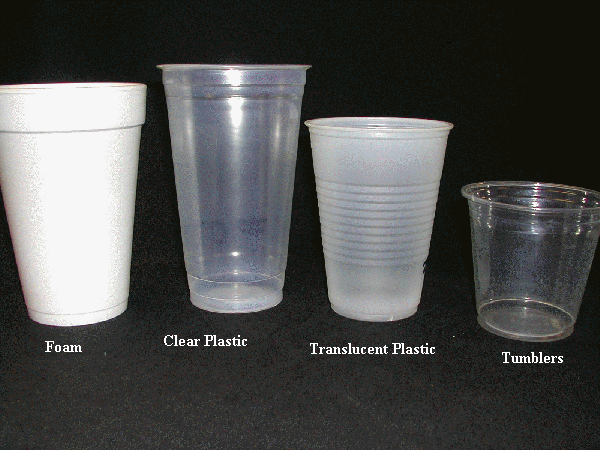
There is a lot of debate over whether paper cups are preferable to polystyrene cups from an environmental point of view. Due to consumer pressure, many fast food and snack food franchises have even switched to paper or cardboard cups. The question is, however, whether paper is really better for the environment than polystyrene cups.
The 3 main choices for disposable cups are paper, polystyrene and PET plastic.
PAPER is the most expensive choice, and despite popular belief, not all paper cups are biodegradable. Many are lined with wax or petrochemical products to waterproof them. Paper production can cause almost twice as much CO2 emissions and energy consumption as creating plastic or polystyrene products. Some paper cups are also not recyclable if they have a wax coating on them. Producing paper cups can also take more material by weight to produce for proper insulation, compared to polystyrene and plastic cups.
A study by Canadian scientist Martin Hocking shows that making a paper cup uses as much petroleum or natural gas as a polystyrene cup. Plus, the paper cup uses wood pulp. The Canadian study said, ‘The paper cup consumes 12 times as much steam, 36 times as much electricity, and twice as much cooling water as the plastic cup.’ And because the paper cup uses more raw materials and energy, it also costs 2.5 times more than the plastic cup.
POLYSTYRENE cups are lightweight and cheap, and can insulate very well but they can degrade or break into smaller pieces that becomes a hazard to the environment and animals. Styrofoam is created from benzene and other chemicals that contribute to smog and global warming. Polystyrene products are not biodegradable and neither practical nor economical to recycle. Polystyrene has been found to break down in oceans, but only into more toxic polymers, where they eventually end up in the food chain of sea birds and marine animals. Researchers from Japan collected water samples from seas in US, Japan, Europe and India, and found that all the water samples were found to contain derivatives of polystyrene, plastics and BPA.
PLASTIC cups seem to be the most environmentally-friendly option as most plastic cups are recyclable, washable and reusable. Plastic is also a much lighter material so there is less transportation and fuel costs needed. Plastic cups are the cheapest to produce and purchase, but the soft versions could not be used for hot drinks.
Now that researchers have found the shockingly large environmental impact of paper cups, what are the choices available to us?
1. Reusable cups are, of course, the preferred choice as the cups will be used many times over, thus reducing the resources needed to make them. They may require water and soap for washing, but this is minimal. Don't forget that disposable cups use a lot of water and chemicals in the manufacturing process as well.
2. If you are entertaining at home, it makes environmental and economic sense to invest in a set of washable, reusable cups. You can lend them out during potlucks, or conversely, borrow a set from friends, thus reducing the need to buy, store and keep track of so many material possessions.
3. Bring your own drinking water and beverages with you when you are outside your home. Politely decline disposable cups and bottled water, and ask for your drink to be served in your own mug, cup or flask when appropriate. Many service staff in restaurants and stalls are only to happy to comply with your request. Starbucks and several other coffee franchises have their own range of "personal reusable tumblers" which they encourage customers to bring and utilise, so if you are a regular patron of coffee franchises, find out if you have the option of bringing and using your own reusable tumbler or mug.
4. If you have no choice but to accept a disposable cup, go for a recyclable plastic cup. Try to reuse or recycle the disposable cups you have acquired. Rinse out and bring home your cups for reuse as pen caddies, planters, paintbrush holders, and yes, drinking cups, before you consign them to the recycling or garbage bin.
(Image credits: http://www.tristatetheatre.com/styrofoam%20Plastic%20cups.htm.)
Sunday, April 15, 2012
Non-woven Reusable Shopping Bags?Maybe not.
SHOPPING BAGS: NON-WOVEN REUSABLE SHOPPING BAGS? MAYBE NOT.
by Cindy Chen
gl.mnselangor@yahoo.com

Non-woven shopping bags
They’re everywhere these days. Just a few evenings ago, attending a state organized function, heaps of bright non-woven reusable bags are being distributed to the crowd. The young ladies behind me were even calling out “eh, ‘dik, bagilebih” (hey kid, give me more).
I rejected at the time thinking I’ve got plenty already. And after reading some articles today. I am glad I did.
It has been reported just late last year that, out of survey 71 non-woven polypropylene bags sold by various grocery chains, 21 had dangerous levels of lead content, the highest being 194ppm. Studies in the past have shown that there is no safe level. Exposure to lead may have detrimental impact on children’s health affecting cognitive ability and behavior as well fertility problems in adults.
While the report was done in the US, I would be on the side of caution even here in Malaysia.
If you are concerned about using these bags, here are some things you could do to stay safer.
-Avoid bags with elaborate illustrations or large photographs.
- Handwash bags, not with other clothes, and dry them in open air.
While some quarters that may or may not have funded the research advocates usage and recycling of plastic bags instead, I think I’ll explore other options (and they are inthe order of my personal preference). Reason? That’s another story.
i) Grandma’s bags – these are all inherited bags I already have at home. Stuff sewn from cut up old clothes, cloth odds and ends etc. Or even just my ‘everything-but-the-kitchen-sink sling bag’ that I lug around daily.
ii) Used boxes – these are boxes that the shops have after the goods inside have been emptied out. Send them for recycling when you’re done.
iii) Woven baskets – natural forest produce baskets woven by local artisans. Support the local crafts industry!
iv) Cotton bags – Bags purpose made as reusable bags. Look for responsibly made ones – e.g. organic, fairly paid artisans. Take good care of them and use them a whole lot more than 173 times to make it worth the carbon footprint.
v) Paper bags & biodegradable bags– if provided by the store, and not having absolutely any other options.

References:
i) Excessive Amounts of Lead Found In Major Reusable Grocery Bags Supplied by Major Retailers, http://www.consumerfreedom.com/news_detail.cfm/h/4368-excessive-amounts-of-lead-found-in-reusable-grocery-bags-supplied-by-major-
ii) Studies Show Danger of Even Small Amounts of Lead in Children’s Blood, http://articles.latimes.com/2010/mar/08/health/la-he-lead-20100308
iii) Analytical results for metals: Reusable Grocery Bags, http://media.tbo.com/tbo/pdfs/1117bagtests.pdf
Biodegradable Plastic Bags
PENCINTA ALAM JANUARY 2011
GREEN LIVING COLUMN
BIODEGRADABLE PLASTIC BAGS
Q: WHAT ARE BIODEGRADABLE PLASTIC BAGS?
There are generally two groups of bio-degradable plastic. Hydro-biodegradable plastics are made from starch-based polymers (derived from tapioca, corn, potato or wheat) while oxo-biodegradable plastics are conventional petroleum-based products with some additives that hasten degradation. When exposed to the right conditions (heat, oxygen and moisture), both will undergo chemical degradation, resulting in a reduce molecular weights. The smaller molecules are then amenable to biodegradation by micro-organisms, which convert the materials to carbon dioxide and water. Some polymers require UV light in order to break (photodegradable polymer) while others need aerobic conditions (compostable polymer).
Q: ARE BIODEGRADABLE PLASTIC BAGS REALLY BETTER FOR THE ENVIRONMENT?
Proponents of biodegradable plastics argue that certified biodegradable plastics combine the utility of plastics (lightweight, resistance, waterproof, relative low cost) with the ability to completely and fully biodegrade in a compost facility, therefore eliminating the problems caused by conventional plastic bags (i.e. high cost of recovering and recycling plastic bags, high wastage, endangerment of wildlife and birds, clogging of waterways and landfills).
There are conflicting views as to the environmental benefits of biodegradable plastic bags. Some reports say the production and disposal of biodegradable plastics use less energy and water, generate less greenhouse gases, and produce less waste. But there are also studies which say otherwise.
Then there are criticisms that most so-called biodegradable plastics only degrade (changes in chemical structure and loss in mechanical properties, resulting in the plastic breaking down into small fragments) and do not biodegrade (break down and be consumed by micro-organisms).
Whatever the argument, it is important for us to remember that biodegradable plastics are not the solution to waste management problems. Biodegradable plastics may even create the idea that it is alright for us to generate and discard waste without due consideration, as long as the waste is biodegradable. As with everyone who is concerned about our natural environment, we need to use less disposable packaging and get into the habit of bringing our own reusable containers and bags.
Q: HOW DO I DETECT GREENWASHING WHEN IT COMES TO BIODEGRADABLE PLASTIC BAGS?
There are various kinds of biodegradable plastic bags in the market, but most are not environmentally-friendly. Companies are mostly claiming biodegradability, and unfortunately the greenwashing has taken over the science. Only bags (or any type of biodegradable plastic, for that matter) that conform to compostability standards ASTM D6400 or EN 13432 are truly biodegradable and can be trusted. Oxo-degradable, oxo-biodegradable, oxy-degradable, oxy-biodegradable, and degradable plastic (bags) are not environmentally friendly. They are merely plastic with a chemical additive.
Check the vendor’s claims about the biodegradable plastic bags. If the bags contain plastic (or technically called Polyethylene), these are not biodegradable bags, but rather plastic mixed with a chemical additive that in a short time interval breaks the plastic molecular ties and thus the plastic disintegrates.
Check if the vendor has certification for the material. The only acceptable certification should be ASTM D6400 and/or DIN EN13432.
If the price of the biodegradable plastic bags is very close to that of plastic bags, you are probably not buying biodegradable but rather the plastic with the additive mentioned above.
** Information compiled from http://thestar.com.my/lifestyle/story.asp?file=/2010/12/7/lifefocus/7548373&sec=lifefocus and http://www.biodegradableplasticbags.org/)
Friday, April 13, 2012
Reducing Paper Wastage In The Office
GREEN LIVING COLUMN PENCINTA ALAM OCTOBER 2009
REDUCING PAPER WASTAGE IN THE OFFICE
By Wong Ee Lynn
[gl.mnselangor@yahoo.com]
FACTS ABOUT PAPER USE AND WASTAGE:
1. The average office worker uses 10,000 sheets of copy paper each year.
2. Over 40% of wood pulp produced in the world goes towards the production of paper.
3. The costs of using paper (i.e. printing, copying, faxing) can run 13-31 times the cost of purchasing the paper in the first place!
4. It takes more than 1 ½ cups of water to produce 1 sheet of paper (Picture a typical soft drink can).
5. Reducing paper use reduces greenhouse gases. 40 reams of paper is equivalent to 1.5 acres of pine forest absorbing carbon dioxide for one year!
6. Even with recycling efforts, paper makes up approximately 25% of the waste we throw away. We are still throwing away a lot of resources!
WAYS TO REDUCE PAPER WASTAGE:
1. Always make double-sided copies.
2. Set computer defaults to print double-sided.
3. Reuse paper printed only on one side in the fax machine, for draft copies and for internal documents.
4. Preview documents before printing. Use the print preview to spot formatting errors and blank pages. Proofread first and use the grammar & spellcheck to avoid errors that will cause documents to be reprinted.
5. Save emails, minutes and other documents onto hard disk. Delete margins, duplicates, contact details, logos, footers and anything unnecessary, and resize and realign the font and paragraphs to take up the least space possible. It makes for easier reading and if the need to print it arises, less paper will be used.
6. Promote a "think before you copy" attitude. Consider sharing some documents with co-workers. Print only the number of copies needed for the meeting, don't make extras.
7. Print or photocopy only the pages you need, and only the number of copies you need. There is no need to make extra copies for standby. If it is in the disk, it can be reprinted as and only when needed.
8. Save a copy of important documents into your hard disk or e-mail folders. Create folders to keep everything organised and retrievable. Fix a date every month to review the folders and delete documents you no longer need.
9. Saving documents on soft copy may even make your life easier! You can just copy and paste from documents, than refer to the printed copy and type everything from scratch again.
10. However: Don’t be a pack rat and save everything to disk, especially when the information is readily available elsewhere! Keep your inbox and hard disk tidy and organised. This will save memory/disk space and prevent the need to purchase additional disk storage or thumb drives.
11. Examine the reports and documents you print regularly to see if people still need them. Many times, they are created for someone who has left or who does not need it anymore.
12. Remove printers from desks and move them to a central location where one printer will suffice for many people. This will reduce wasteful printing as people will decide it is too much hassle to print unnecessary and personal items.
13. Have an inter-departmental competition to see which dept uses the least paper. Give each Dept a fixed number of reams of paper a week, and mark the packaging, e.g. with Dept X #1, #2 and so forth for each ream. At the end of each week, reward the dept that has the most unused reams of paper remaining. Of course, you will need to take into account the fact that some office departments, say, the Legal Dept, will need to use more paper than the others.
14. Impose a fine on those found to be wasting paper, e.g. crumpling up once-used paper and tossing it into their wastepaper basket when they should be putting it back into the printer tray for drafts. Even crumpled paper can be reused as memo pads.
15. Give members/subscribers/customers/clients the option of going paperless and of receiving newsletters, correspondence, catalogues and other documents via email. Of course, this is not possible where there are legal issues, e.g. acceptance of contract, admission of liability etc, so in those instances, resize and reformat before printing and print on both sides if you can. If a hard copy is going to be sent to you, then don’t print out the email.
16. Unplug the fax machine and request that the sending party email instead. That way, you have more control over whether something should be printed, and you can resize and reformat it before printing. This will also eliminate junk mail by fax. At least try to unplug the fax machine after official office hours.
17. Keep copiers and printers in good repair and make it policy to only buy copiers and printers that make reliable double-sided copies. Let your copier maintenance person know when a copier is performing poorly (toner is low, jams frequently, etc.). Regular copier maintenance is important, especially if the toner is low. Copiers are often used until all the toner is gone and that wears down machines. A copier that works well is less likely to jam and this helps save paper.
(Topic proposed by Ling Mee Hong)
Recycling Aluminium Foil and other Household Metals
GREEN LIVING COLUMN PENCINTA ALAM JANUARY 2009
RECYCLING ALUMINIUM FOIL AND OTHER HOUSEHOLD METALS
By Wong Ee Lynn
The Green Living SIG was recently asked the following question at an MNS event: “Can aluminium foil be recycled?”
Pure aluminium foil can be recycled and will be accepted by recycling collection centres together with your aluminium cans. Foil items can include:
• kitchen foil
• foil milk bottle tops
• baking and freezing trays
• takeaway and ready-meal containers
Silver-look packaging such as snack and potato chip packets and chocolate wrappings CANNOT be recycled.
To determine if something is aluminium, you can do the Scrunch Test: If the foil can be crushed or scrunched up, and does not spring back into shape, it is probably aluminium. If it bounces back, then it is plastic, NOT aluminium. Foil wrapping such as chocolate wrappers and shiny giftwrap that have a paper underside are foil-coated paper and CANNOT be recycled.
Please make sure all aluminium foil and containers are clean and free of oil and food residue before being recycled.
WHY RECYCLE ALUMINIUM?
Aluminium is produced from bauxite, a clay-like ore that is rich in aluminium compounds. The aluminium is only found as a compound called alumina, which is a hard material consisting of aluminium combined with oxygen. This alumina has to be stripped of its oxygen in order to free the aluminium. The alumina is dissolved in a molten salt at a reduction plant and a powerful electric current is run though the liquid to separate the aluminium from the oxygen. This process uses large quantities of energy.
Recycling 1kg of aluminium saves up to 6kg of bauxite, 4kg of chemical products and 14 kWh of electricity.
Recycling aluminium requires only 5% of the energy and produces only 5% of the CO2 emissions as compared with primary production and reduces the waste going to landfill. Aluminium can be recycled indefinitely, as reprocessing does not damage its structure. Aluminium is also the most cost-effective material to recycle.
A recycled aluminium can saves enough energy to run a television for 3 hours.
OTHER METALS
Although present in smaller quantities - all metals, including nickel, copper, silver, gold, lead, brass and more, can be recycled. Given their recognised value, a smaller quantity of these metals are in circulation. However, despite the reliance on these metals by specific industries, eg. electronics, their presence is often neglected when householders dispose of items.
A Factsheet On Plastic Bags
GREEN LIVING COLUMN PENCINTA ALAM NOVEMBER 2008
A FACTSHEET ON PLASTIC BAGS
Forwarded by Hellen Tan, compiled by Wong Ee Lynn
1. Data released by the United States Environmental Protection Agency shows that somewhere between 550 billion and a trillion plastic bags are consumed worldwide each year.
2. Less than 1% of plastic bags are recycled. It costs more to recycle a bag than to produce a new one.
3. According to Jared Blumenfeld, Director of San Francisco’s Department of the Environment: “There’s harsh economics behind bag recycling: It costs $4,000 to process and recycle 1 ton of plastic bags, which can then be sold on the commodities market for $32.”
SO, WHERE DO OUR PLASTIC BAGS GO?
4. A study by the US Academy of Sciences in 1975 showed that oceangoing vessels together dumped 8 million pounds of plastic annually. The real reason that the world’s landfills weren’t overflowing with plastic was because most of it ended up in our oceans!
5. The British Antarctic Survey disclosed that plastic bags have been found floating north of the Arctic Circle near Spitzbergen, and as far south as the Falkland Islands.
6. The US National Marine Debris Monitoring Programme reports that plastic bags account for over 10% of the debris washed up on the US coastline.
7. Plastic bags do photodegrade. Over time, they break down into smaller, more toxic petro-polymers, which eventually contaminate our soil and waterways. As a consequence, microscopic particles can enter the food chain.
8. The effect of plastic bags on wildlife can be catastrophic. The World Wildlife Fund reports that birds can get terminally entangled, and nearly 200 different species of sea life including whales, dolphins, seals and turtles die due to plastic bags. Most die after ingesting plastic bags, which they mistake for food.
WHAT CAN WE DO TO CHANGE THIS?
9. Bangladesh and Rwanda have banned plastic bags, China has outlawed the giving out of ‘free’ plastic bags and Ireland took the lead in Europe, taxing plastic bags in 2002. Ireland has now reduced plastic bag usage by 90%.
10. Israel, Canada, western India, Botswana, Kenya, Tanzania, South Africa, Taiwan and Singapore have also banned or are moving towards banning the plastic bag.
11. Plastic shopping bags are made from polyethylene, a thermoplastic made from oil. Reducing plastic bags will save oil and energy. CNN Asia reported that China will save 37 million barrels of oil each year due to its ban on free plastic bags.
12. If we use a cloth shopping/grocery bag, we can save 6 bags a week. That’s 24 bags a month, or 288 bags a year, for each of us. This adds up to 22,176 plastic bags in an average lifetime.
The choice is ours. Recycling used plastic bags isn’t a solution. Reducing plastic bag usage and carrying your own shopping bags and takeaway containers is. Do something drastic – cut the plastic!
A Factsheet On Bottled Drinking Water
PENCINTA ALAM OCTOBER 2008
Green Living Column
A FACTSHEET ON BOTTLED DRINKING WATER
Contributed by Dr. Jessie Cheah, edited by Wong Ee Lynn.
E-mail: gl.mnselangor@yahoo.com
Bottled drinking water has higher economic and environmental costs than most of us would realise. The facts below, which were collated by the Pacific Institute, may be able to persuade you to fill your own water tumblers instead of purchasing bottled drinking water:
1. According to the Beverage Marketing Corporation, Americans bought a total of 31.2 billion litres of bottled drinking water in 2006. Most of this water was sold in polyethylene terephthalate (PET) bottles, requiring nearly 900,000 tons of plastic. PET is produced from fossil fuels – typically petroleum, a non-renewable resource.
2. According to the plastics manufacturing industry, it takes around 3.4 megajoules of energy to make a typical one-litre plastic bottle, cap, and packaging. Making enough plastic to bottle 31.2 billion litres of water required more than 106 billion megajoules of energy. Because a barrel of oil contains around 6 thousand megajoules, the Pacific Institute estimates that the equivalent of more than 17 million barrels of oil were needed to produce these plastic bottles.
3. The manufacture of every ton of PET produces around 3 tons of carbon dioxide (CO2). Bottling water thus created more than 2.5 million tons of CO2 in 2006.
4. In addition to the water sold in plastic bottles, the Pacific Institute estimates that twice as much water is used in the production process. Thus, every litre sold represents three litres of water.
5. More energy is needed to fill the bottles with water at the factory, move it by truck, train, ship, or air freight to the user, cool it in grocery stores or home refrigerators, and recover, recycle, or throw away the empty bottles. The Pacific Institute estimates that the total amount of energy embedded in our use of bottled water can be as high as the equivalent of filling a plastic bottle one quarter full with oil.
Subscribe to:
Posts (Atom)